
Table of Contents
Hospital Estimate in India: How to Read It and Avoid Paying More Than You Should
By Priya, nurse and pharmacist | Last reviewed: October 18, 2026
A hospital estimate in India is a written forecast of your treatment cost, not your final bill. To avoid overpaying, ask for an itemised estimate in writing, find out what is excluded, ask what happens if you stay longer or need more treatment, confirm the deposit and refund terms, and get a receipt for every payment. Compare at least three estimates by what each one includes, not just the total.
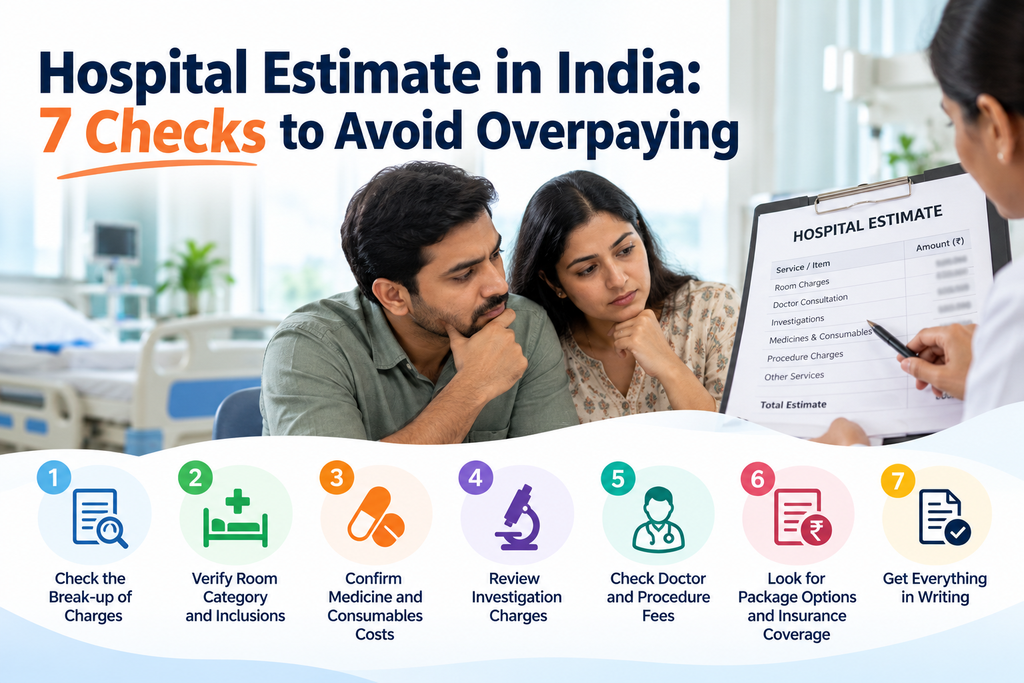
MediGlobe does not rank hospitals or sell treatment. Our approach is Pay Fair, Stay Safe: we teach you how to check things yourself. This guide shows you how to read a hospital estimate, what to ask before you pay, and how to spot the problems that cause unnecessary costs.
What a Hospital Estimate in India Is (and Is Not)
An estimate is the hospital’s best prediction of your cost, based on your reports and the treatment planned. It is not a fixed price.
Your final bill can differ from the estimate because:
- your condition may need more or different treatment than expected
- you may need extra days in the hospital or in intensive care
- a complication may need further care
- items that were never in the estimate may be added
That is why the question is not “how much is the estimate?” but “what exactly does it cover, and what happens if something changes?”
Your Rights on Rates and Bills in India
India’s Ministry of Health and Family Welfare has a Charter of Patients’ Rights. It states that patients have the right to information on the rates charged for each type of service, which the clinical establishment should display at a conspicuous place in the local language and in English. It also gives patients the right to access their case papers, records, investigation reports and a detailed, itemised bill.
The charter also covers medicines and devices. It says patients have the right to essential medicines, devices and implants at rates fixed by the National Pharmaceutical Pricing Authority.
Two cautions:
- The Charter is a national guideline. How it is applied can differ by state and by hospital, so do not assume every hospital follows it in the same way.
- It was written for patients in India. Ask the hospital to confirm how these rules apply to international patients.
Even so, you are entitled to ask for rates and an itemised bill. A hospital that answers clearly gives you confidence. A hospital that avoids the question tells you something.
What a Good Itemised Estimate In India Includes
An itemised estimate lists each charge separately. Look for these lines:
| Item | What to ask |
|---|---|
| Surgeon or doctor fees | Is it one fee or split between several doctors? |
| Anaesthesia | Is it included? |
| Operation theatre charges | Are consumables included? |
| Room category | Which room, and for how many days? |
| ICU | Is any ICU time included? If not, what does a day cost? |
| Nursing and hospital services | Included in the room rate? |
| Tests and scans | Which tests, and how many? |
| Medicines and consumables | Included for the stay and for discharge? |
| Implants and devices | Which brand and model? Is it the one named in the plan? |
| Physiotherapy | How many sessions? |
| Taxes and other charges | Are they included in the total? |
If the estimate is only one total with no breakdown, ask for the breakdown before you decide.
What May Be Excluded or Extra
Many unexpected costs come from things that were never in the estimate. Ask directly about:
- additional hospital days
- ICU stay if it is needed
- treatment of complications
- a second procedure
- a different or upgraded implant
- medicines to take home
- blood products
- extra tests or scans
- interpreter services
- airport transfers
- follow-up consultations and tele-consults
For each item, ask: is it included, or extra, and what does it cost? Get the answer in writing.
Package or Itemised Estimate?
Some hospitals offer a package price. A package can be useful, because it gives you one number. But it can also hide what is missing. Ask:
- How many days does the package cover?
- What is included, and what is not?
- What triggers an extra charge?
- Who decides whether extra treatment is needed, and how is it explained to me?
- What happens to the package if my plan changes?
A package should still come with a written list of inclusions and exclusions.
7 Checks to Avoid Overpaying
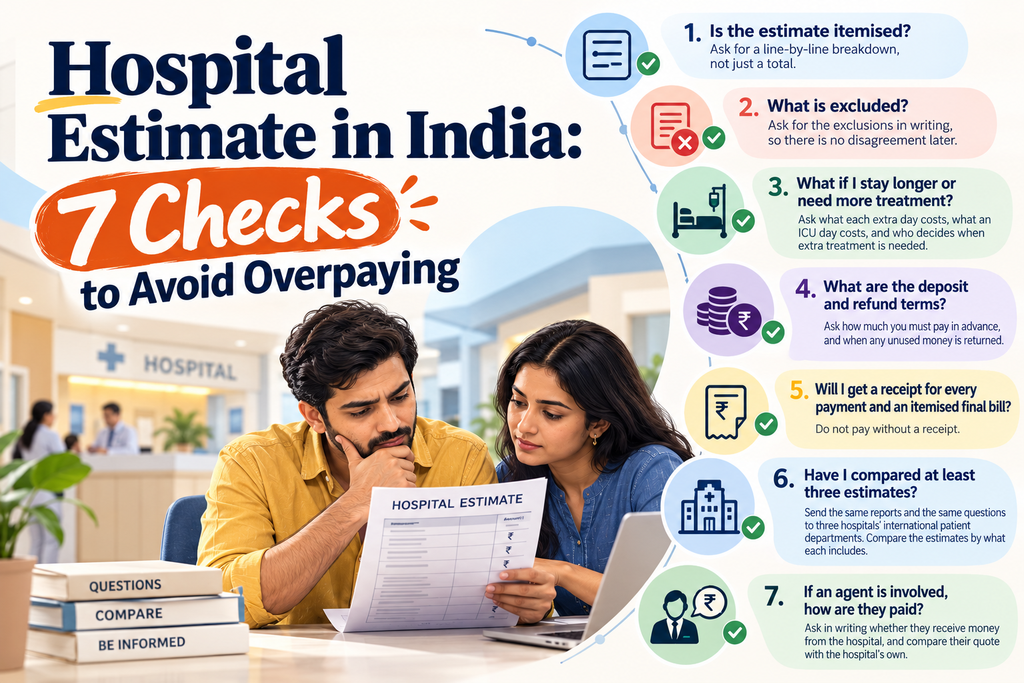
1. Is the estimate itemised?
Ask for a line-by-line breakdown, not just a total.
2. What is excluded?
Ask for the exclusions in writing, so there is no disagreement later.
3. What if I stay longer or need more treatment?
Ask what each extra day costs, what an ICU day costs, and who decides when extra treatment is needed.
4. What are the deposit and refund terms?
Ask how much you must pay in advance, and when any unused money is returned.
5. Will I get a receipt for every payment and an itemised final bill?
Do not pay without a receipt.
6. Have I compared at least three estimates?
Send the same reports and the same questions to three hospitals’ international patient departments. Compare the estimates by what each includes.
7. If an agent is involved, how are they paid?
Ask in writing whether they receive money from the hospital, and compare their quote with the hospital’s own.
How to Compare Three Estimates Side by Side
Use one simple table. Fill in the same lines for each hospital:
| Check | Hospital A | Hospital B | Hospital C |
|---|---|---|---|
| Itemised? (yes/no) | |||
| Total estimate | |||
| Room category and days | |||
| ICU included? | |||
| Implant (brand and model) | |||
| Excluded items | |||
| Extra-day cost | |||
| Deposit and refund terms | |||
| Reply speed and clarity |
Do not choose by the lowest total. A lower estimate that excludes ICU, implants or medicines may end up costing more. Compare what is inside each quote.
Deposits, Receipts and Payment Safety
- Pay the hospital, not individuals. Use the hospital’s official payment counter or its official bank account, and check the account name.
- Get a receipt for every payment, with the date, amount and what it was for.
- Never pay an agent in cash without a matching receipt from the hospital.
- Ask for the refund terms in writing before you pay a deposit.
- Keep copies of the estimate, receipts and messages, on paper and on your phone.
Red Flags
- the hospital refuses to give a written estimate
- a price is given only by phone or message, with no document
- an estimate is given without any review of your reports
- pressure to pay quickly or “today only” offers
- a promise of a fixed price “whatever happens”
- a request to pay into a personal account
- charges on the bill that were not in the estimate, with no explanation
If you see any of these, slow down and ask questions before you pay.
Discharge Day: Check Your Final Bill
Before you leave:
- compare the final bill with the estimate, line by line
- ask the billing team to explain any difference in writing
- collect the itemised final bill and all payment receipts
- ask for any unused deposit to be refunded, and note when it will arrive
- collect your discharge summary, reports and scans
Do this before you check out. Fixing a mistake is much harder once you have left.
Questions to Ask an Agent
If you use a medical travel agent or facilitator, ask:
- Who pays you: the hospital, me, or both?
- Can you show me the hospital’s own quote?
- Will you show me more than one hospital for my treatment?
- Do you charge me any extra fee? For what?
- Who is responsible if something goes wrong?
A trustworthy agent answers plainly. Be cautious if they avoid the questions or push you to decide fast.
How MediGlobe Approaches This
MediGlobe aims to protect international patients from unsafe choices and unnecessary payments. We teach you the checks, and we cite our sources and dates.
Hospital Estimate In India Checklist
- I have a written, itemised estimate
- I know what is included and excluded
- I know the cost of an extra day and of ICU
- I know which implant or device is planned
- I have the deposit and refund terms in writing
- I will pay only to the hospital’s official account or counter
- I will get a receipt for every payment
- I compared at least three estimates
- I asked any agent how they are paid
- I will check the final bill against the estimate before I leave
Frequently Asked Questions
What is a hospital estimate in India?
It is a written forecast of the cost of your treatment, based on your reports and the planned procedure. It is not a final price, and the bill can change if your treatment changes.
Can the final bill be higher than the estimate?
Yes. Longer stays, ICU care, complications or extra treatment can all add to it. Ask what is excluded and what each extra item costs.
Do hospitals in India have to give an itemised bill?
The Ministry of Health’s Charter of Patients’ Rights says patients have the right to an itemised bill. How it is applied differs by state and hospital, so ask for one in writing before you pay.
Should I choose the lowest estimate?
Not automatically. Compare what each estimate includes. A low total can leave out items that you will need.
How many estimates should I compare?
At least three, from different hospitals’ international patient departments, using the same reports and questions.
Is it safe to pay through an agent?
Ask for a receipt from the hospital for every payment, and check how the agent is paid. Where possible, pay the hospital directly.
Sources
- Charter of Patients’ Rights and Responsibilities (Ministry of Health and Family Welfare, updated August 2021), via ruralindiaonline.org (accessed October 18, 2026)
- Charter of Patients’ Rights, Clinical Establishments portal, Ministry of Health and Family Welfare: clinicalestablishments.mohfw.gov.in (accessed October 18, 2026)
- National Pharmaceutical Pricing Authority: nppaindia.nic.in (check current rates and rules)
Educational information, not medical or legal advice. Always ask for written estimates and receipts, and verify a hospital’s accreditation on official websites before you travel for treatment.
About the author: Priya is a nurse and pharmacist (B.Sc. Nursing, D.Pharm) with around 8 years of clinical and academic experience, and the founder of MediGlobe.