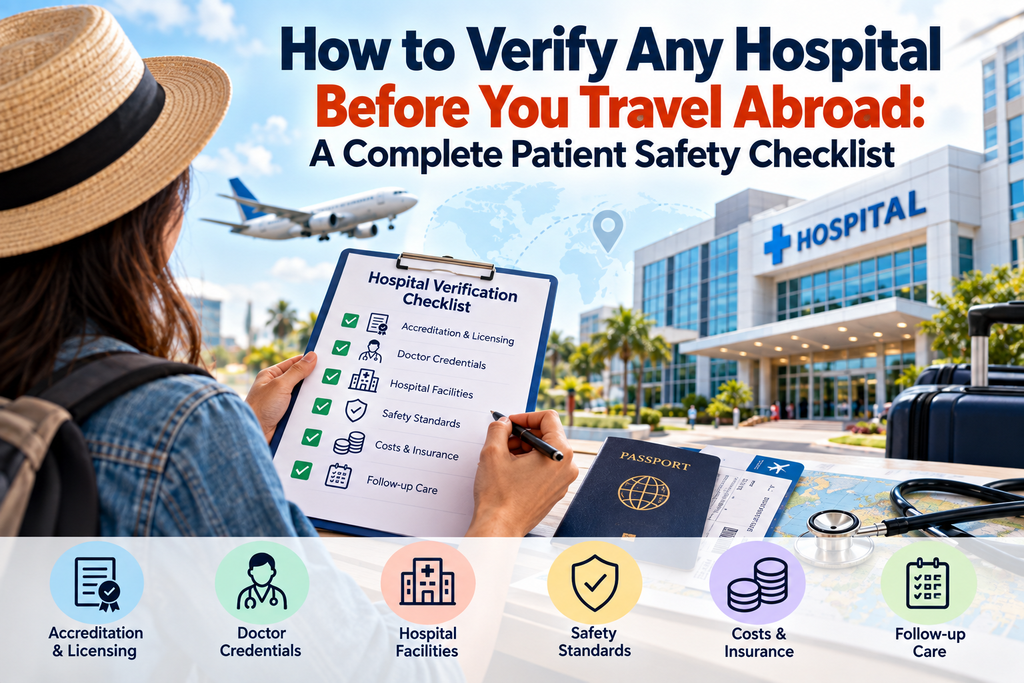
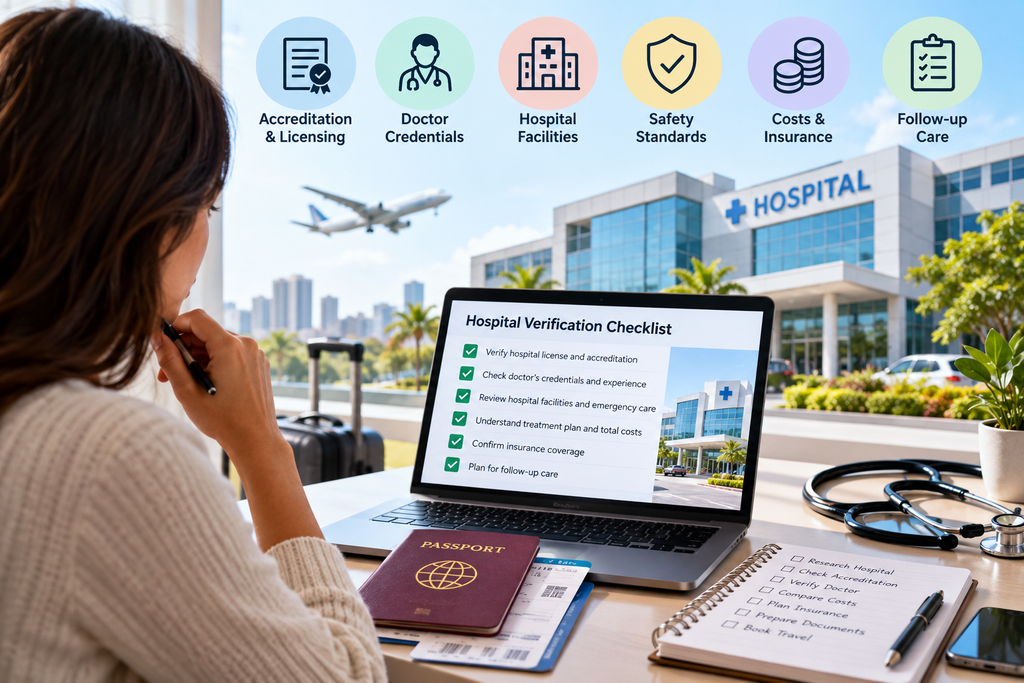
How to Verify Any Hospital Before You Travel Abroad: A Complete Patient Safety Checklist
Table of Contents
Traveling abroad for medical treatment can offer access to specialized care, experienced doctors, advanced facilities, or potentially lower treatment costs. But choosing a hospital in another country requires more than checking its website, reading online reviews, or comparing treatment prices.
A hospital may have an impressive building and a professional-looking website without necessarily being the right facility for your particular treatment.
Before booking a flight, you should verify the hospital, the treating doctor, the facility’s licensing and accreditation, the treatment itself, the expected costs, emergency arrangements, and your plan for follow-up care after returning home.
This guide explains how to verify a hospital before traveling abroad for medical treatment—and the warning signs that should make you stop and investigate further.
Important: This article is for general information and does not replace advice from a qualified doctor, travel-medicine specialist, or local healthcare regulator. Accreditation can provide useful information about a facility’s quality systems, but it does not guarantee a complication-free procedure or a particular medical outcome.
Why You Should Verify a Hospital Before Traveling Abroad
Healthcare standards, licensing systems, professional qualifications, medical regulations, and available resources can vary between countries and even between hospitals in the same city.
The CDC specifically advises people considering medical tourism to research both the healthcare professional and the facility before traveling. It also notes that accreditation does not guarantee a successful medical outcome.
There are several reasons hospital verification matters:
The hospital may not be appropriately licensed for the treatment you need.
The doctor may have qualifications that are difficult to verify.
The hospital’s accreditation may have expired or may apply only to certain services.
The facility may not have the intensive-care, blood-bank, imaging, laboratory, or emergency resources your procedure could require.
The advertised treatment price may exclude important services.
Communication problems can lead to misunderstandings about treatment.
Complications may require additional treatment after you return home.
Medical records may not be available in a format your doctors at home can easily use.
Your insurance may not cover treatment or complications arising from treatment abroad.
Patient safety is a global healthcare concern. The World Health Organization identifies medication errors, unsafe surgery, healthcare-associated infections, diagnostic errors, patient identification problems, and unsafe blood transfusions among potential sources of preventable harm.
The goal of verification is therefore not to find a hospital that looks impressive online. It is to determine whether the facility is legitimate, appropriately qualified, adequately equipped, transparent, and suitable for your specific medical needs.
Step 1: How To Verify That the Hospital Actually Exists
Start with the most basic question:
Is this a legitimate healthcare facility operating at the address being advertised?
Do not rely solely on photographs, promotional videos, or a medical-tourism company’s website.
Check:
The hospital’s complete legal name.
Its physical address.
Official telephone numbers.
The hospital’s own website.
The relevant government healthcare registry.
The facility’s license or registration number, where applicable.
Whether the facility is currently operating.
Whether the advertised department or specialty actually exists at that location.
Search for the hospital independently rather than clicking only the links supplied by an intermediary.
A useful approach is to search the hospital name together with terms such as:
“[Hospital Name] license”
“[Hospital Name] accreditation”
“[Hospital Name] regulator”
“[Hospital Name] medical license”
“[Hospital Name] complaints”
The exact regulator will depend on the country.
Step 2: Check the Hospital’s Accreditation
One of the most important verification steps is checking whether the facility has recognized accreditation.
International healthcare accreditation organizations assess hospitals against defined quality and patient-safety standards. The CDC identifies organizations such as Joint Commission International (JCI) and other recognized accreditation bodies as resources patients can use when researching facilities abroad.
For example, JCI maintains requirements for hospitals seeking accreditation, including requirements concerning licensing and hospital operations.
However, there is an important distinction:
Do not simply look for an “accredited” logo on a hospital website. Verify the accreditation directly with the accrediting organization.
Check:
The name of the accredited organization.
Accreditation status.
Accreditation dates.
Whether the accreditation is currently valid.
Whether it applies to the specific hospital location.
Whether it applies to the type of service you need.
What if the hospital is not internationally accredited?
Lack of international accreditation does not automatically mean that a hospital is unsafe or unsuitable.
Some countries rely heavily on national or regional accreditation systems.
For example, healthcare accreditation in India includes the National Accreditation Board for Hospitals & Healthcare Providers (NABH), which operates under the Quality Council of India.
The important point is to identify the relevant official accreditation and licensing systems in the destination country and verify the facility through those systems rather than relying on marketing claims.
Step 3: How To Verify the Doctor—Not Just the Hospital
A reputable hospital does not automatically mean that every doctor working there is the right doctor for your procedure.
Research the specific physician who will treat you.
Check:
Full name.
Medical degree.
Specialty.
Specialist certification.
Medical license.
Current registration status.
Hospital privileges.
Relevant training.
Experience with your particular procedure.
Whether the doctor personally performs the procedure.
Whether another doctor could perform some or all of the treatment.
Whenever possible, verify the doctor’s registration through the country’s official medical regulator or licensing authority.
Be especially careful when a medical-tourism company says something like:
“You will be treated by one of the country’s leading specialists.”
Ask for the doctor’s full name and credentials and verify them independently.
Step 4: Verify Experience With Your Specific Procedure
A hospital may perform thousands of procedures every year, but that does not necessarily mean it performs your particular procedure frequently.
Ask specific questions.
For example:
How many procedures of this type does the hospital perform annually?
How many has the specific doctor performed?
How long has the doctor been performing this procedure?
What are the common complications?
What happens if a complication occurs?
Is intensive-care support available if needed?
Is an experienced specialist available 24/7 in an emergency?
How long will you normally remain in the hospital?
What follow-up appointments are required?
You should be looking for specific, verifiable answers, not vague statements such as “We have extensive experience.”
Step 5: Investigate Patient Safety and Infection Control
Hospital appearance is not a reliable measure of patient safety.
A modern lobby, luxury room, or sophisticated website tells you little about infection prevention, medication safety, surgical protocols, or emergency response.
Ask the hospital about:
Infection-control procedures.
Surgical-site infection prevention.
Antibiotic policies.
Sterilization procedures.
Blood-bank availability.
Emergency response.
Intensive-care facilities.
Patient identification procedures.
Medication management.
Laboratory services.
Diagnostic imaging.
Emergency surgery availability.
The WHO identifies healthcare-associated infections, medication errors, unsafe surgical procedures, diagnostic errors, and unsafe transfusions among important patient-safety concerns.
You may not receive every statistic you request, but a reputable facility should be able to explain its safety systems clearly.
Step 6: Find Out What Happens If Something Goes Wrong
This is one of the most overlooked questions in medical tourism.
Do not ask only:
“How much does the procedure cost?”
Also ask:
“What happens if I develop a complication?”
Find out:
Is emergency treatment available at the hospital?
Is an intensive-care unit available?
Is emergency surgery available?
Is a blood bank available?
Who pays for treatment if complications occur?
Will the hospital continue treating you if additional treatment is required?
Is additional hospitalization included in your package?
Who is responsible for arranging emergency transportation?
What happens if you need to stay longer than planned?
What happens if you need treatment after returning home?
These questions matter because the cost of an overseas procedure does not necessarily represent the total potential cost.
The CDC specifically recommends considering follow-up care and the financial consequences of complications after returning home.
Step 7: Check Whether the Hospital Has the Equipment You May Need
Do not assume that a hospital offers every service simply because its website lists a specialty.
For your specific treatment, ask whether the hospital has access to:
Intensive-care facilities.
Appropriate operating theatres.
Blood-bank services.
Diagnostic imaging.
Laboratory testing.
Pathology.
Cardiac monitoring.
Emergency medicine.
Specialist consultations.
Rehabilitation.
Pharmacy services.
Specialized equipment required for your procedure.
For complex treatment, ask whether these services are available on-site or outsourced to another facility.
That distinction can be important.
Step 8: Verify the Hospital’s Location
Location matters more than many international patients realize.
A hospital may be excellent but located several hours away from the airport or from suitable accommodation.
Check:
Distance from the airport.
Typical travel time.
Ambulance availability.
Nearby accommodation.
Accessibility for people with disabilities.
Availability of pharmacies.
Availability of follow-up care nearby.
Emergency hospitals in the surrounding area.
If you are traveling for a procedure that could require urgent treatment, knowing the local emergency infrastructure is especially important.
The CDC notes that the availability and level of medical care can vary not only between countries but also within countries, and that more healthcare choices are generally available in urban areas than in remote locations.
Step 9: Verify Communication and Language Support
Language barriers can create serious problems in healthcare.
Before traveling, determine:
Which languages your doctor speaks.
Whether the hospital has professional medical interpreters.
Whether consent forms are available in a language you understand.
Whether nurses and other staff can communicate with you.
Who you can contact outside normal office hours.
Whether your discharge instructions will be provided in a language you understand.
Do not assume that a hospital’s international-patient department automatically means that every healthcare professional speaks your language.
The CDC specifically warns that communication challenges can result in misunderstandings about care.
Step 10: Get a Written Treatment Plan
Before paying a deposit or booking flights, request a written treatment plan.
It should ideally identify:
Your diagnosis.
Recommended procedure or treatment.
Name of the treating doctor.
Expected hospital stay.
Expected recovery period.
Follow-up schedule.
Required tests.
Possible alternatives.
Major risks and complications.
What happens if the planned procedure changes.
If the hospital refuses to explain the treatment clearly before you travel, consider that a reason to pause and obtain another medical opinion.
Step 11: Get a Detailed Written Cost Estimate
A low advertised price can be misleading if important services are excluded.
Ask for an itemized estimate covering:
Doctor’s fees.
Hospital charges.
Operating-room charges.
Anesthesia.
Medical devices or implants.
Medicines.
Laboratory tests.
Imaging.
Room charges.
Intensive-care charges.
Follow-up appointments.
Additional hospital days.
Emergency treatment.
Translation or interpreter services.
Transportation.
Taxes and other mandatory fees.
Then ask:
“Which costs are not included in this estimate?”
That question can be more useful than simply asking for the total price.
The CDC’s medical-tourism guidance recommends understanding exactly which services are included because follow-up care and other additional services can result in substantial extra charges.
Step 12: Understand the Hospital’s Refund and Cancellation Policy
Medical conditions can change.
You may also discover after a second medical opinion that you should not proceed with the planned treatment.
Before paying a deposit, ask for written terms covering:
Cancellation.
Refunds.
Rescheduling.
No-show charges.
Changes in treatment.
Changes in medical condition.
Additional procedures.
Complications.
Hospital-initiated cancellation.
Do not rely on verbal promises from a sales representative.
Step 13: Verify the Medical Tourism Agency Separately
If you are using a medical-tourism agency or facilitator, remember:
The hospital and the agency are two different entities.
Verify both.
Ask:
Who owns the agency?
Where is it legally registered?
Does it receive commissions from hospitals?
How are doctors selected?
Can you speak directly with the hospital?
Can you contact the doctor without the intermediary?
Who handles complaints?
Who is responsible if arrangements fail?
Are additional hospitals available if you change your mind?
Be particularly cautious if an intermediary pressures you to make a quick payment.
You should be able to conduct your own research and obtain an independent medical opinion.
Step 14: Be Careful With Reviews and Testimonials
Online reviews can be useful, but they should not be your primary method of evaluating a hospital.
Look for patterns rather than isolated comments.
For example, search for:
Hospital name + complaints
Hospital name + patient experience
Hospital name + accreditation
Doctor name + disciplinary action
Hospital name + regulator
Hospital name + malpractice
Hospital name + infection
But remember that online reviews can be incomplete, biased, manipulated, or impossible to verify.
A five-star rating does not prove medical quality.
Likewise, one negative review does not necessarily prove that a hospital is unsafe.
Use reviews as one piece of evidence, not as your verification system.
Step 15: Ask for Independent Medical Records and Outcome Information
For complex treatment, ask whether the hospital can provide relevant information about outcomes.
Depending on the procedure and jurisdiction, useful information might include:
Procedure volume.
Complication rates.
Readmission rates.
Infection rates.
Mortality statistics where relevant.
Patient-safety indicators.
Quality reports.
Not every hospital will publish all of this information, and definitions may differ between facilities.
If statistics are provided, ask:
“What period do these numbers cover, and how are they calculated?”
A number without context can be misleading.
Step 16: Check Your Insurance Before You Travel
Never assume that your regular health insurance will cover planned medical treatment abroad.
Ask your insurer:
Is treatment abroad covered?
Is planned surgery covered?
Are complications covered?
Is emergency hospitalization covered?
Is medical evacuation covered?
Is repatriation covered?
Is follow-up care after returning home covered?
Are pre-existing conditions covered?
Is there a maximum benefit?
Do you need prior authorization?
The CDC recommends reviewing insurance coverage and considering appropriate travel health and medical evacuation insurance when traveling for healthcare.
Get the answers in writing.
Step 17: Plan Your Follow-Up Care Before Leaving Home
One of the biggest mistakes medical tourists make is thinking only about the procedure.
Your treatment does not end when you leave the hospital.
Before traveling, identify:
Who will manage your recovery abroad?
How many follow-up visits are required?
When can you safely fly home?
Who will remove stitches or dressings?
Who will review laboratory results?
Who will manage complications?
Who will provide rehabilitation?
Who will care for you after you return home?
The CDC recommends arranging follow-up care before traveling and obtaining copies of medical records from the overseas facility before returning home.
Step 18: Ask How Soon You Can Safely Fly Home
Do not book a return flight simply because the hospital package says you will stay for a certain number of days.
Your safe travel date should be determined based on your medical situation and the procedure performed.
Flying after surgery can increase the risk of complications such as blood clots, and the appropriate waiting period can vary depending on the operation and your individual circumstances.
Ask your treating doctor:
“What medical criteria must I meet before I am cleared to fly?”
That is more useful than asking:
“How many days should I stay?”
Step 19: Get Copies of All Your Medical Records
Before leaving the destination country, obtain copies of your medical information.
Depending on your treatment, this may include:
Diagnosis.
Medical history.
Operative report.
Discharge summary.
Medication list.
Imaging reports.
Imaging files where available.
Laboratory results.
Pathology reports.
Implant information.
Anesthesia records.
Follow-up instructions.
Prescriptions.
Keep both digital and physical copies where practical.
The CDC specifically recommends bringing relevant records when traveling for medical care and obtaining copies of records from the overseas facility before returning home.
Step 20: Verify Your Medications Before Traveling
Medication rules vary by country.
A medicine that is legal and commonly prescribed in your home country may be restricted or controlled elsewhere.
Before departure, check the destination country’s rules and carry appropriate documentation.
The CDC advises travelers to check destination-country requirements and, where necessary, carry prescriptions or medical certificates.
Keep medicines in their original packaging and carry a current medication list.
A Simple Hospital Verification Checklist
Before booking treatment abroad, work through this checklist.
Hospital verification
Hospital’s legal name verified
Physical address verified
Hospital license verified
National/local regulator checked
Accreditation independently verified
Accreditation is current
Accreditation applies to the correct facility
Relevant department verified
Required equipment confirmed
ICU/emergency facilities confirmed where relevant
Blood-bank services confirmed where relevant
Infection-control procedures discussed
Language support confirmed
Doctor verification
Doctor’s full name confirmed
Medical license verified
Specialty verified
Relevant qualifications verified
Experience with your procedure discussed
Doctor’s role in your treatment confirmed
Independent medical opinion obtained
Financial verification
Written treatment estimate received
Included services listed
Excluded services identified
Additional-day charges understood
Complication costs discussed
Cancellation/refund policy received
Payment terms documented
Insurance coverage confirmed
Travel and recovery
Travel insurance reviewed
Medical evacuation coverage considered
Follow-up care arranged
Return-flight timing discussed with doctor
Accommodation arranged
Local transportation planned
Emergency contact information saved
Medical records prepared
Red Flags: When You Should Stop and Investigate Further
Be cautious if you encounter several of these warning signs:
1. Pressure to pay immediately
A reputable healthcare decision should not feel like a limited-time sales promotion.
2. Guaranteed medical results
No legitimate medical provider can guarantee that every patient will achieve a particular outcome.
3. Extremely vague credentials
If the hospital or doctor refuses to provide names, licenses, qualifications, or other basic information, investigate further.
4. Accreditation logos without verification
A logo on a website is not the same thing as independently verified accreditation.
5. No written treatment plan
You should understand what treatment is being proposed before traveling.
6. No itemized quotation
A single unexplained package price makes it difficult to determine what you are actually paying for.
7. Refusal to discuss complications
Every procedure has risks. A provider should be able to discuss what happens if something does not go according to plan.
8. No clear follow-up plan
If the hospital cannot explain who will care for you after treatment, ask more questions before proceeding.
9. Requests for unusual payment methods
Be cautious about requests for payments that cannot be properly documented or traced.
10. The hospital cannot be independently verified
If you cannot confirm the facility through credible sources, pause before making travel or payment arrangements.
Questions to Ask the Hospital Before Booking
You can copy this list and send it to the hospital’s international-patient department.
What is the hospital’s full legal name and license number?
Which organization currently accredits the hospital?
When does the accreditation expire?
Does the accreditation cover the department where my treatment will take place?
Who will personally perform my procedure?
What are the doctor’s qualifications and license details?
How many procedures of this type does the doctor perform?
What are the major risks and possible complications?
What emergency facilities are available?
Is an ICU available if required?
Is blood-bank support available?
What infection-control measures are in place?
What tests are included in my treatment?
What exactly is included in the quoted price?
What is not included?
What happens if I require additional treatment?
How long will I need to remain in the country?
When will I be medically cleared to fly?
What follow-up care is included?
Who will provide care if I develop a complication after returning home?
Can I receive my complete medical records before leaving?
Can I speak directly with the treating physician before booking?
What is the cancellation and refund policy?
What payment methods are accepted?
What emergency contact number can I use 24/7?
Hospital Verification: A 10-Minute Quick Check
If you are at the early research stage and want a quick screening process, use this sequence:
1. Search the hospital independently
Do not rely solely on the medical-tourism company’s website.
2. Check the government healthcare regulator
Look for the hospital’s license or registration.
3. Check accreditation directly
Verify the hospital through the accrediting organization’s own records.
4. Verify the doctor
Check the doctor’s license, specialty, and relevant credentials.
5. Search for independent information
Look beyond promotional websites and testimonials.
6. Request a written treatment plan
Make sure you know exactly what is being proposed.
7. Request an itemized price
Find out what is included and excluded.
8. Ask about complications
Know what happens if the procedure does not go as planned.
9. Arrange insurance and follow-up care
Do this before booking the procedure.
10. Get an independent medical opinion
Discuss the treatment with a qualified healthcare professional who is not financially connected to the overseas provider.
Should You Choose an Internationally Accredited Hospital?
International accreditation can be a useful part of your due-diligence process because it indicates that an external organization has evaluated the facility against defined standards.
However, accreditation should be treated as one verification layer—not a guarantee of medical success.
The CDC explicitly notes that accreditation does not guarantee a positive outcome.
A sensible evaluation therefore looks at several factors together:
Accreditation + licensing + doctor credentials + procedure-specific experience + hospital resources + safety systems + transparency + follow-up care
rather than relying on any single factor.
What About Hospital Rankings?
Hospital rankings can be useful for general research, but they should not replace individual verification.
A hospital can rank highly overall while not necessarily being the most appropriate facility for your specific procedure, condition, age group, or medical needs.
Instead of asking:
“Is this hospital famous?”
ask:
“Is this hospital appropriately licensed, qualified, equipped, experienced, and prepared for my specific treatment?”
That is a much more useful question.
What If the Hospital Is Recommended by a Friend?
Personal recommendations can be helpful, but they are not a substitute for verification.
Your friend’s procedure may have been different from yours. Their doctor may have been different. Their medical history, recovery, and risk factors may also have been different.
Use recommendations as a starting point for research, not as proof of suitability.
What If the Hospital Is Much Cheaper?
A lower price does not automatically mean lower quality.
Healthcare costs vary significantly between countries and healthcare systems.
However, you should compare the total cost of care, not just the advertised procedure price.
A treatment that appears inexpensive initially may become considerably more expensive if additional services are excluded.
The Most Important Rule: Verify Before You Travel
Medical tourism should be approached as a healthcare decision first and a travel decision second.
Before you book your flight, verify:
The hospital. The doctor. The license. The accreditation. The treatment. The equipment. The safety systems. The price. The insurance. The emergency plan. The follow-up plan. And your medical records.
Do not let attractive pricing, impressive photographs, online testimonials, or pressure from an intermediary replace proper due diligence.
The CDC recommends researching both the healthcare facility and the treating clinician, arranging appropriate insurance, planning follow-up care, and obtaining medical records when receiving care abroad.
The safest decision is an informed decision made with qualified medical advice and independent verification.
Frequently Asked Questions
How do I check whether a foreign hospital is legitimate?
Start by verifying its physical address, legal name, license, and registration with the relevant healthcare authority in that country. Then independently verify any claimed accreditation through the accrediting organization’s official records.
Is hospital accreditation enough?
No. Accreditation can be useful evidence that a facility has undergone an external assessment, but it does not guarantee a particular medical outcome. You should also verify the doctor, licensing, relevant experience, equipment, emergency services, costs, insurance, and follow-up arrangements.
How do I verify a doctor abroad?
Look for the country’s official medical licensing or registration authority. Verify the doctor’s name, license status, specialty, and relevant qualifications. You should also ask about experience with your specific procedure.
Should I get a second medical opinion before traveling abroad?
For planned or major treatment, obtaining an independent medical opinion can help you understand whether the proposed treatment is appropriate and what alternatives may exist.
What should I ask a hospital before paying a deposit?
Ask for the doctor’s identity and credentials, hospital license and accreditation information, treatment plan, itemized cost estimate, cancellation policy, complication arrangements, follow-up plan, and expected recovery and travel timeline.
Does a low-cost hospital mean poor quality?
Not necessarily. Healthcare costs differ between countries and systems. However, price should never be the only criterion. Compare the complete scope of care, qualifications, facilities, safety systems, insurance, and follow-up arrangements.
What documents should I bring when traveling for medical treatment?
Bring relevant medical records, diagnostic reports, imaging, prescriptions, medication lists, allergy information, insurance documents, and contact details for your doctors and emergency contacts. Ask the overseas facility for complete copies of your treatment records before returning home.
How long should I stay abroad after surgery?
There is no universal number of days. The appropriate period depends on the procedure, your recovery, complications, and your treating doctor’s assessment. Ask your doctor what clinical criteria you need to meet before flying home.
Can I rely on online hospital reviews?
Reviews can provide information about patient experiences, but they should not be treated as proof of clinical quality. Combine them with licensing, accreditation, doctor credentials, facility information, and other independently verifiable evidence.
What should I do if a hospital refuses to provide credentials?
Pause the process and investigate further. A prospective patient should be able to obtain basic information about the facility and treating clinician. If important information cannot be independently verified, consider seeking another provider.
Final Takeaway
Choosing a hospital abroad is not simply about finding the lowest price or the hospital with the most impressive website.
Before traveling, perform independent checks on the facility, accreditation, licensing, doctor credentials, treatment experience, patient-safety systems, emergency capabilities, costs, insurance, and follow-up care.
Take your time, ask detailed questions, obtain important information in writing, and discuss the proposed treatment with a qualified healthcare professional.