
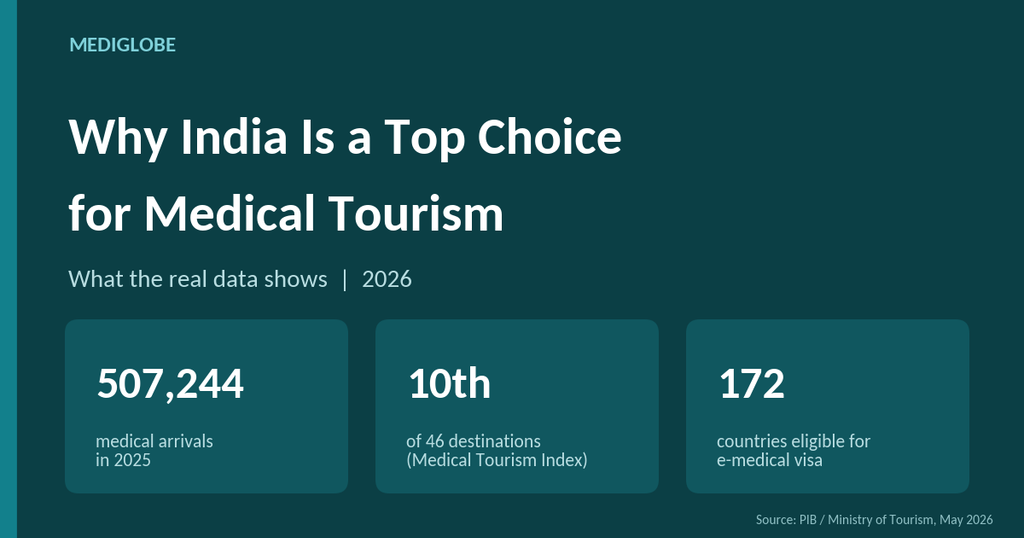
India recorded 507,244 foreign arrivals for medical treatment in 2025, about 5.5% of all foreign tourist arrivals, and ranks 10th among 46 destinations in the Medical Tourism Index 2020-21. India is not the cheapest destination for every procedure, and it is not ranked first. What it offers is a rare combination: large patient volume, treatment prices far below Western levels, a very large hospital and doctor base, and a visa system built for patients. This guide walks through each of those points with the real numbers, and shows where India falls short.
Key facts at a glance
- Medical arrivals, 2025: 507,244, out of 9.15 million foreign arrivals
- Market size: about US$8.7 billion in 2025, projected to reach US$16.2 billion by 2030
- Global context: the worldwide medical travel market was about US$115.6 billion in 2022, projected at US$286.1 billion by 2030
- Hospitals and doctors: 69,364 hospitals and about 1.2 million registered doctors
- Visa access: e-medical visa available to nationals of 172 countries
India in the global medical tourism picture
Patients travel abroad for treatment because of high costs, long waiting times and growing lifestyle-disease burdens at home. The government’s own brief puts the global medical travel market at roughly US$115.6 billion in 2022, growing at about 10.8% a year. India’s share of that is modest but growing. Industry estimates place India’s market at about US$8.7 billion in 2025, nearly doubling by 2030. On rankings, the Medical Tourism Index 2020-21 placed India 10th of 46 destinations. A separate ranking from industry sources lists Turkey and Thailand ahead of India in medical visitor numbers. India is a strong contender, not the undisputed leader.
How many patients actually come to India?
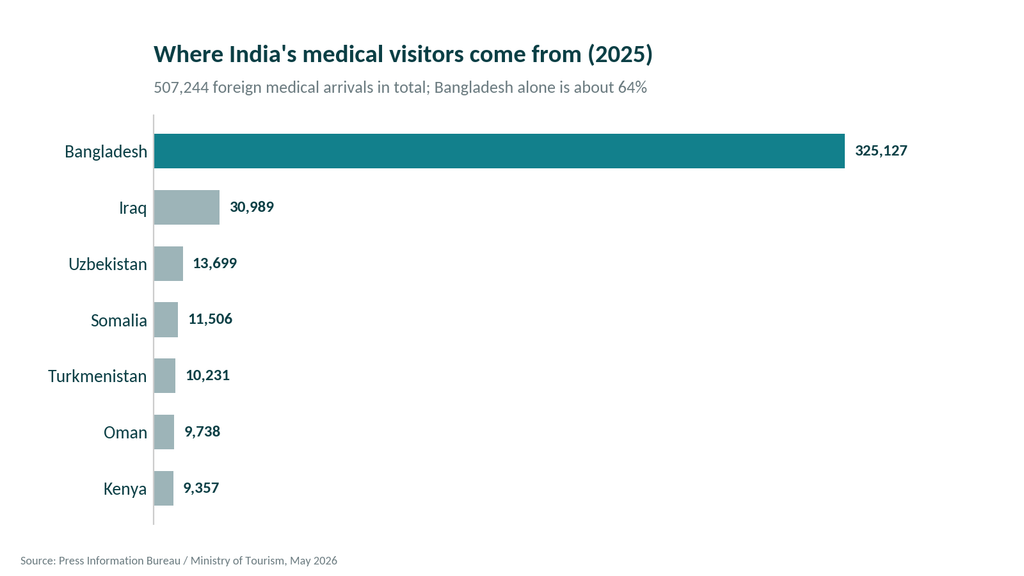
The 2025 figure is 507,244 medical visitors. The top source countries show where demand comes from:
- Bangladesh: 325,127
- Iraq: 30,989
- Uzbekistan: 13,699
- Somalia: 11,506
- Turkmenistan: 10,231
- Oman: 9,738
- Kenya: 9,357
Bangladesh alone is about 64% of the total. That concentration means India’s numbers depend heavily on one neighbouring market, and a change in visa policy or relations there moves the whole total.
Patients mainly travel for cardiac surgery, orthopaedics, cancer treatment, organ transplants, neurological procedures, fertility treatment, dental care, cosmetic surgery and AYUSH-based wellness therapies.
The trend is not a straight line upward. India recorded about 6.5 lakh medical visitors in 2023. The 2025 figure of 507,244 is roughly a fifth lower. Anyone writing “booming” about Indian medical tourism should note that volumes have fallen from the 2023 level
How much cheaper is treatment in India?
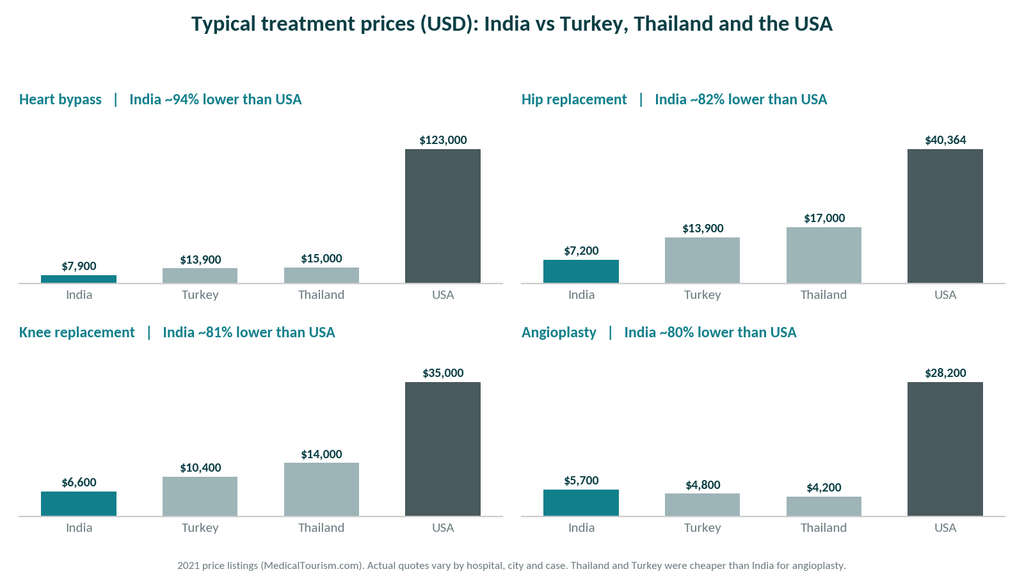
Cost is the main reason patients look at India. A 2021 price comparison from MedicalTourism.com listed these typical prices (USD):
| Procedure | India | Turkey | Thailand | USA |
|---|---|---|---|---|
| Heart bypass | $7,900 | $13,900 | $15,000 | $123,000 |
| Hip replacement | $7,200 | $13,900 | $17,000 | $40,364 |
| Knee replacement | $6,600 | $10,400 | $14,000 | $35,000 |
| Angioplasty | $5,700 | $4,800 | $4,200 | $28,200 |
Worked out against the US prices, India is about 94% cheaper for heart bypass, about 82% for hip replacement, about 81% for knee replacement and about 80% for angioplasty. Against Turkey and Thailand, India is cheapest for bypass, hip and knee in this dataset, but not for angioplasty, where Thailand and Turkey are lower.
Three cautions apply to any price table:
- These are 2021 listings. Prices have moved since.
- Real quotes depend on the hospital, the city, the surgeon, the room category and the complexity of your case.
- The surgery is not the whole bill. Add flights, accommodation, an attendant, follow-up visits and a buffer for complications.
Hospitals, doctors and language
India has 69,364 hospitals, of which 43,486 are private and 25,778 are public, with about 1.2 million registered doctors. The government says this meets the WHO-recommended doctor-to-population ratio. English is the main language of medical education and clinical practice, which helps communication with international patients.
International patients mostly use private hospitals in a handful of cities. Medical travel providers are concentrated in the southern and western states. The cities leading in medical tourism include Chennai, Mumbai, New Delhi, Ahmedabad, Goa, Bengaluru and Kochi.
Accreditation: what the numbers say
Accreditation is how you separate hospitals that meet checked quality standards from those that simply advertise well. India has two systems patients encounter.
NABH (India’s national accreditation body). The number depends on the source and on what is counted:
- A Rajya Sabha reply lists 4,650 NABH-accredited hospitals as of December 31, 2024, with the most in Haryana, Maharashtra and Delhi. da
- The government’s May 2026 brief states that NABH has accredited over 1,299 hospitals against more than 600 safety parameters.
The two figures are far apart and likely count different things, so read them as “between roughly 1,300 and 4,650 depending on the definition”. Don’t rely on a single headline number. Check the specific hospital’s status on the NABH website.
JCI (an international accreditation). As of 2022, India had 27 JCI-accredited hospitals across nine cities, led by Delhi (9) and Mumbai (6). That is a small group compared with India’s total hospital count. Most patients will be treated in hospitals that hold NABH, JCI or neither.
Accreditation means a hospital meets defined standards. It does not guarantee your outcome. See our guide on how to verify any hospital before you travel.
Visas and logistics
India runs a dedicated visa system for patients.
- The e-medical visa and e-medical attendant visa are available to nationals of 172 countries.
- Commonly listed terms: 60 days of stay, three entries for follow-up visits, and up to two attendants per patient. Applications are generally made at least four days before travel. These terms come from visa-service websites, so confirm them on the official Indian e-visa portal before booking.
- A separate AYUSH visa was introduced on 27 July 2023 for treatment under traditional systems such as Ayurveda.
The government is also building infrastructure around patients. Plans include an upgraded medical travel portal covering booking, payment and post-operative care, concierge lounges at important airports, and five Regional Medical Hubs proposed in the 2026-27 Union Budget. The government is also encouraging the registration and rating of medical travel facilitators. Those are announced plans and proposals. Check what exists on the day you travel.
Where India falls short
An honest picture includes the weaker points:
- Ranking: 10th in the index, behind other destinations on patient volume.
- Falling volume: medical arrivals dropped from about 6.5 lakh in 2023 to 507,244 in 2025.
- One-market dependence: about 64% of patients come from Bangladesh.
- Angioplasty is cheaper elsewhere: Thailand and Turkey were lower in the 2021 data.
- Few internationally accredited hospitals: 27 JCI hospitals as of 2022, in nine cities.
- Uneven quality: accreditation varies, and facilitators are only now being rated.
- Dated price data: public comparison tables lag behind current hospital pricing.
What to check before choosing India
- Confirm the hospital’s NABH or JCI status on the accreditor’s own website.
- Check the surgeon’s qualifications and how many times they perform your procedure.
- Ask for a written, itemised estimate, including what is not covered.
- Ask how complications are handled and who pays.
- Plan the follow-up care you will need after returning home.
- Check the visa terms on the official portal.
- Talk to your own doctor before deciding.
- How to verify any hospital
The bottom line
India makes sense for many patients because it pairs very low prices with a large pool of doctors, English-language care and a visa pathway designed for patients. It is not the best choice for every procedure or every patient, and the data shows both strengths and weaknesses. Compare India against your other options using current quotes, and verify every hospital yourself.
FAQ
Is India good for medical tourism?
Yes, for many patients. It has high patient volume, prices well below Western countries, many doctors and an e-visa system for patients. Suitability depends on the treatment, the hospital and your health.
How many people travel to India for treatment?
507,244 foreign nationals came for medical treatment in 2025.
Which countries send the most patients to India?
Bangladesh by a wide margin (325,127), then Iraq, Uzbekistan, Somalia and Turkmenistan.
How much cheaper is heart bypass in India than in the US?
In 2021 price data, about $7,900 in India against $123,000 in the US, roughly 94% lower.
Is India cheaper than Turkey and Thailand?
For bypass, hip and knee replacement in the 2021 data, yes. For angioplasty, no.
How many JCI-accredited hospitals does India have?
As of 2022, 27, across nine cities.
Do I need a visa for medical treatment in India?
Most foreign patients do. An e-medical visa is available to nationals of 172 countries. Check eligibility and terms on the official Indian e-visa portal.
Is treatment in India safe?
Many hospitals hold national or international accreditation, but quality varies. Verify the hospital, the doctor and the procedure before you travel.
Sources: Press Information Bureau, “Medical and Wellness Tourism in India” (May 2026); Ministry of Tourism, Rajya Sabha reply (Aug 2025); Ministry of Health, Rajya Sabha reply on NABH hospitals (Feb 2025); MedicalTourism.com price comparison (2021). Last updated: October 2026.
Medical disclaimer: This article is general information, not medical advice. Consult a qualified doctor before deciding on treatment abroad.
About the author: Priya, B.Sc. Nursing, D.Pharm, HCISPP, with 8 years of clinical and academic experience.