
Taking Medicines Abroad for Medical Treatment: How to Pack and What to Carry.
Table of Contents
By Priya, nurse and pharmacist | Last reviewed: October 15, 2026
Taking medicines abroad for medical treatment needs planning. Carry your medicines in their original packs, note the generic name of each one, and bring a doctor’s letter that lists them all. Check the rules of the country you are travelling to before you fly, because some medicines are restricted and the rules differ from country to country.
In this guide, I explain how to pack your medicines, what documents to carry, how to handle controlled medicines, what to do on the flight, and how to manage medicines during and after your treatment. I am a nurse and a pharmacist, so I have seen how a small medicine mistake can cause big problems for patients who are far from home.
Why Taking Medicines Abroad Needs Planning
When you travel for treatment, your medicines are part of your medical care. They tell your surgical team about your health, and they affect how safely your procedure can be planned.
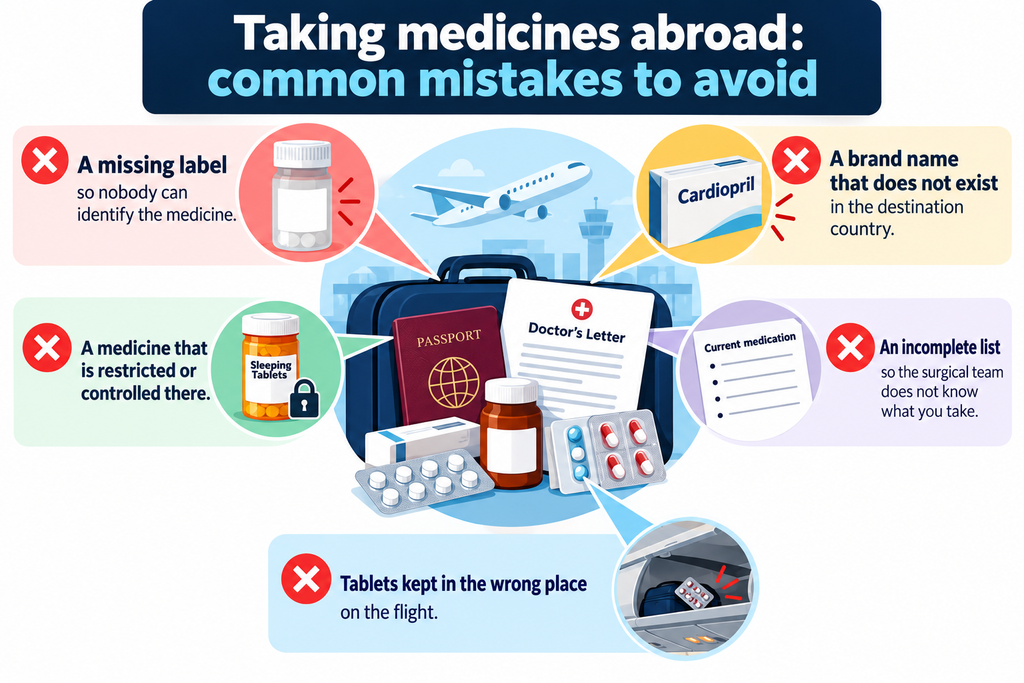
Problems usually come from small gaps:
- a missing label, so nobody can identify the medicine
- a brand name that does not exist in the destination country
- a medicine that is restricted or controlled there
- an incomplete list, so the surgical team does not know what you take
- tablets kept in the wrong place on the flight
A few minutes of preparation weeks before you fly can prevent most of these problems.
Start Early: Talk to Your Doctor and Pharmacist
Do not leave medicine planning to the last week. Several weeks before you travel, talk to your own doctor and your pharmacist. Ask them:
- Which of my medicines should I carry, and in what quantity?
- Is any of my medicine restricted or controlled in the destination country?
- Should I continue or pause any medicine before surgery?
- How should I store my medicines during travel?
- Can you write me a letter listing all my medicines?
Your pharmacist can also print an up-to-date medicine list for you. If you take many medicines, ask for a review so that nothing is missing or out of date.
Original packs make taking medicines abroad much easier at customs and airport security.
Do not move tablets into loose bags, pill boxes or unmarked containers for the journey. The original pack shows the medicine name, strength, batch number and expiry date. It helps customs officers, airline staff, doctors and pharmacists identify it quickly.
A weekly pill organiser is fine for daily use once you arrive, but carry the original packs as well. Keep the leaflet, if there is one, because it shows the active ingredient.
Health guidance for travellers also advises carrying medicines in hand luggage, including those bought over the counter. Your checked bag can be delayed or lost, and you may need your medicines during the flight.
Write Down the Generic Name, Not Just the Brand
A brand name is what the company calls the product. The generic name is the active ingredient, and it stays the same everywhere. A medicine sold under one brand name in your country may have a different brand name abroad, or may not be sold there at all.
For each medicine, write down:
- the generic name (active ingredient)
- the brand name you use at home
- the strength, for example in milligrams
- how often you take it and at what time
- what you take it for
A doctor or pharmacist abroad can use the generic name to find the same or a suitable medicine if you lose yours. Keep this list on paper and on your phone.
A doctor’s letter is the most useful document when taking medicines abroad.
Ask your own doctor for a signed letter on the clinic’s letterhead. Ask for it in English, or in the language of the destination country if possible. The letter should include:
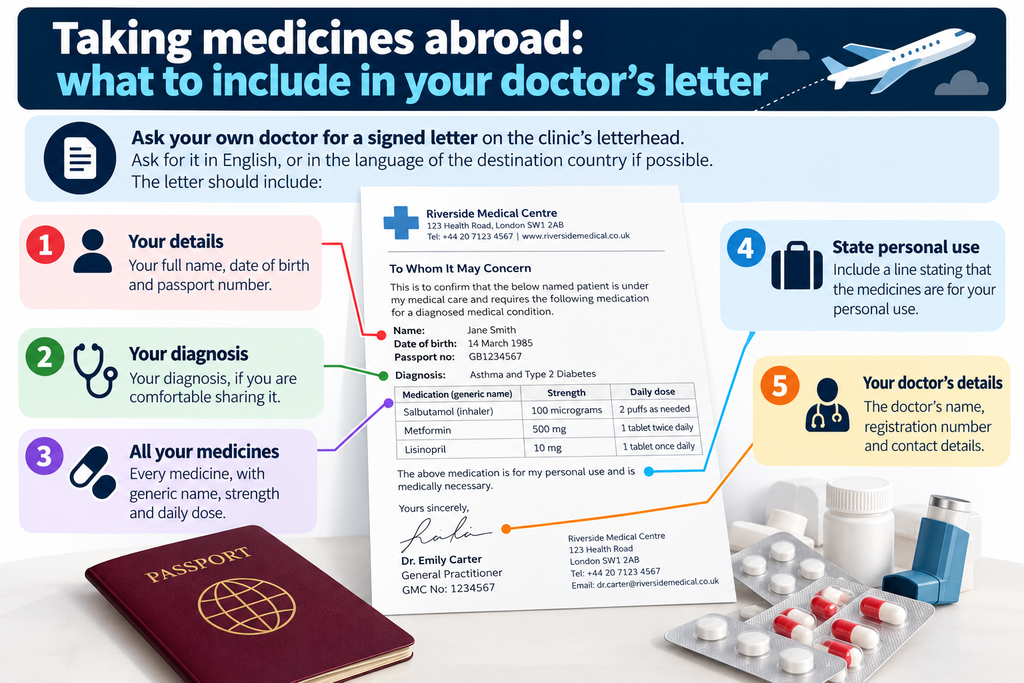
- your full name, date of birth and passport number
- your diagnosis, if you are comfortable sharing it
- every medicine, with generic name, strength and daily dose
- a line stating that the medicines are for your personal use
- the doctor’s name, registration number and contact details
Guidance for travellers also advises carrying a copy of your prescription together with a covering letter from your doctor.
Here is a simple wording your doctor can adapt:
“This is to confirm that [Name], born [date], is under my care and has been prescribed the following medicines for personal use: [generic name, strength, dose]. Please allow the patient to carry these medicines for the duration of their travel.”
Keep a photo of the letter and your prescriptions on your phone as a backup, and ask a family member to keep a copy too.
When taking medicines abroad, carry enough for the whole trip, plus extra in case your return is delayed.
Carry enough for the whole trip, plus extra in case your return is delayed. Recovery can take longer than planned, and flights can be cancelled. Ask your doctor how many extra days of supply are sensible for you.
Do not carry far more than you need. Large quantities can raise questions at customs, and for some medicines, supply limits apply. Do not split your supply by giving some to a friend or relative to carry. The medicines you carry should match your own prescription and your own letter.
Taking Controlled Medicines Abroad: Check the Rules First
Some medicines are controlled because they can be misused. These include some strong painkillers, sedatives, sleeping tablets and stimulants. A medicine that is common and legal in your country can be restricted somewhere else.
Rules differ widely, and whether you need a letter describing your medicines varies a lot between countries. In the UK, for example, travellers may need an export licence to take a larger supply (usually three months or more) of certain controlled drugs. Other countries have their own rules.
If you take a medicine that may be controlled:
- check the destination country’s customs or embassy website before you book
- ask your doctor whether you need a permit or licence
- allow extra time, since permits can take weeks
- never assume that a medicine that is normal at home is allowed abroad
If a medicine is not allowed, ask your doctor early about a permitted alternative. Do not stop or change a medicine on your own.
Rules for Taking Medicines Abroad to India
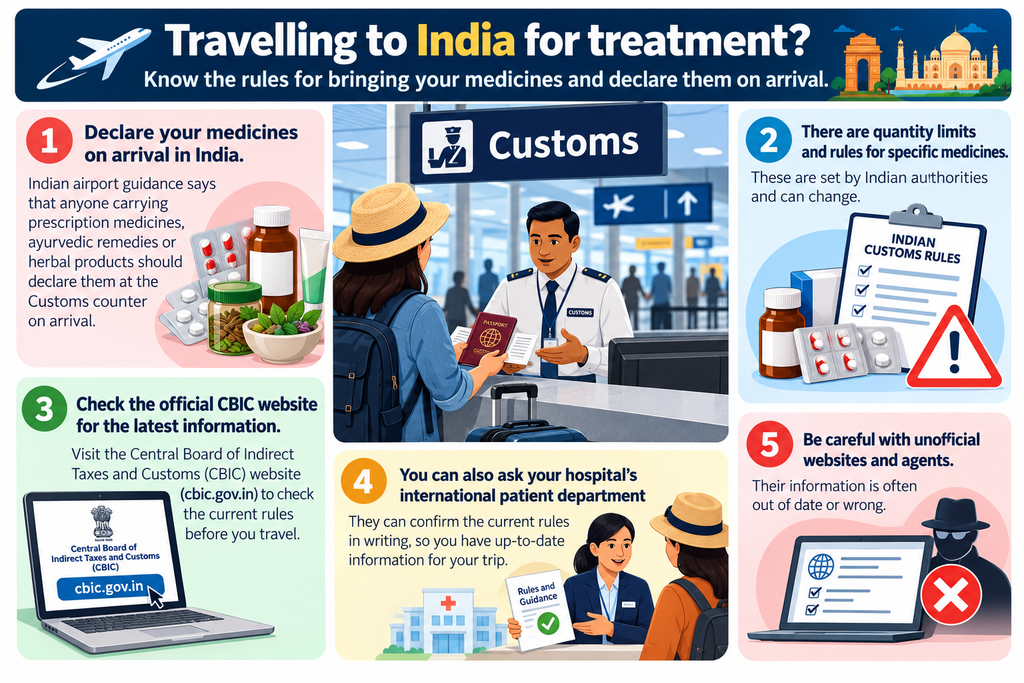
If you are travelling to India for treatment, declare your medicines on arrival. One Indian airport’s guidance says that anyone carrying prescription medicines, ayurvedic remedies or herbal products should declare them at the Customs counter on arrival.
Quantity limits and rules for specific medicines are set by Indian authorities and can change. Check the official Central Board of Indirect Taxes and Customs (CBIC) website (cbic.gov.in), or ask the hospital’s international patient department to confirm the current rules in writing before you travel. Be careful with unofficial websites and agents, because their information is often out of date or wrong.
Hand Luggage, Security and Storage
Pack your medicines in a clear bag in your hand luggage, with your letter and prescriptions on top so you can show them quickly.
A few practical points:
- Liquids, injections and devices: rules at airports and airlines differ. Check them in advance, and carry your letter and prescription for needles, insulin pens or liquid medicines.
- Temperature-sensitive medicines: some medicines must stay cool, such as certain injectables. Ask your pharmacist how to store them, and pack a cool bag if advised. Never leave medicines in a hot car or in direct sunlight.
- Hot climates: heat can damage some medicines. Keep them in a cool, dry place at your accommodation.
- Spare supply: split your supply between two bags of your own, both in your hand luggage or with your companion, so a lost bag does not leave you without medicines.
Time Zones and Dosing
When you cross time zones, your usual medicine times may not fit the local clock. This matters most for medicines that must be taken at regular intervals, such as medicines for the heart, diabetes or seizures. Ask your doctor or pharmacist before you travel how to adjust timings. Do not change doses on your own. Set phone alarms to match the new schedule once your doctor has agreed it.
Tell Your Surgical Team About Everything You Take
Before the procedure, give your surgical team a complete list. Include:
- prescription medicines
- over-the-counter medicines, such as painkillers
- vitamins, supplements and herbal products
- any allergies and past reactions to medicines
Some medicines, such as blood thinners, can affect bleeding and surgery planning. Some supplements can also interact with medicines or anaesthesia. Ask your doctor which medicines to continue and which to pause before surgery. Never stop a medicine on your own. Follow the instructions given by your doctor and the surgical team.
Check the Medicines You Receive Abroad
After surgery, the hospital will give you new medicines. Before you leave, make sure you understand each one:
- Ask for the generic name, the dose, how often to take it and for how long.
- Check that the label has your name and that the pack is sealed and in date.
- Ask what each medicine is for and what side effects to watch for.
- Ask whether the new medicines are safe with the ones you already take.
- Ask for a written medicine list as part of your discharge summary.
Your doctor at home will need this list for follow-up care. If something is unclear, ask a nurse or the hospital pharmacist. It is your right to understand your medicines.
Avoid Buying Medicines From Unlicensed Sellers
If you need extra medicine while abroad, buy it from the hospital pharmacy or a licensed pharmacy. Do not buy from street sellers, unknown websites or an agent who “has a supplier.” Falsified and substandard medicines exist, and they can be harmful. Ask the hospital which pharmacy they recommend, and keep the receipt and the pack.
Bring Your Medicine List Home
When you return, show your doctor at home the full list of medicines you were given, including any changes. Take the original packs, the discharge summary and the letter from your surgical team. This helps your doctor continue your care safely and spot any problem early.
Common Mistakes When Taking Medicines Abroad
- putting all medicines in checked luggage
- transferring tablets into unlabelled containers
- travelling without a doctor’s letter
- assuming a medicine is legal because it is common at home
- forgetting supplements and herbal products when listing medicines
- stopping or changing a medicine without asking your doctor
- buying medicines from unlicensed sellers
- not keeping a spare copy of the medicine list
Taking Medicines Abroad Checklist
- Talked to my doctor and pharmacist several weeks before travel
- All medicines in original packs, in hand luggage
- Generic names, strengths and doses written down
- Doctor’s letter and copies of prescriptions
- Photos of the letter and prescriptions on my phone
- Destination rules checked (customs or embassy), including for controlled medicines
- Storage plan for medicines that need cooling
- Supplements and herbal products listed
- Complete list given to the surgical team
- Extra supply for a few days, as advised by my doctor
Frequently Asked Questions
Do I need a doctor's letter for taking medicines abroad?
Answer: Requirements vary by country, but a letter is widely advised and is essential for controlled medicines. Carry one even if the destination does not ask for it.
What if my medicine is restricted in the destination country?
Do not take it without permission. Contact the embassy or customs authority and your doctor before you travel. Your doctor may suggest a permitted alternative, but only your doctor can decide that.
Can I carry my medicines in my hand luggage?
Yes, and it is advised. Check airline and airport rules for liquids, injections and devices, and carry your letter and prescriptions with you.
Should I tell the hospital about supplements and herbal products?
Yes. They can interact with medicines and anaesthesia, so list them all.
Can I buy my medicines abroad instead of carrying them?
It may be possible, but brand names, strengths and quality controls differ. Talk to your doctor and the hospital pharmacy first, buy only from licensed pharmacies, and do not switch medicines on your own
What should I do if I lose my medicines while travelling?
Contact your surgical team or the hospital pharmacy, and show your doctor’s letter and medicine list. The generic names help them find a suitable replacement. Do not take someone else’s medicines.
Sources
- TravelHealthPro (UK National Travel Health Network and Centre), “Medicines and travel”: travelhealthpro.org.uk/factsheet/43/travelling-with-medicines (accessed October 15, 2026)
- Navi Mumbai International Airport, Narcotics Control Regulations passenger guidance: niairport.in (accessed October 15, 2026)
- Central Board of Indirect Taxes and Customs (CBIC): cbic.gov.in (check current rules)
Educational information, not medical advice. Always talk to your own doctor and the hospital before travelling for treatment.
About the author: Priya is a nurse and pharmacist (B.Sc. Nursing, D.Pharm) with around 8 years of clinical and academic experience, and the founder of MediGlobe.