
By Priya, B.Sc. Nursing, D.Pharm | MediGlobe | Last updated: November 2026
Table of Contents
Short answer: Most patients can fly after surgery to home anywhere from 24 hours to 6 weeks after surgery, depending on the procedure, anaesthesia, complications, and flight length. Minor procedures (dental work, LASIK, hair transplant) often allow flying within 1 to 3 days. Major surgeries (joint replacement, open abdominal, cardiac, neurosurgery) usually need 2 to 6 weeks or more. Never book your return flight until your surgeon confirms a date in writing.
Key Takeaways
- The three main risks of flying too soon are blood clots (DVT), trapped gas expanding at altitude, and bleeding or wound problems far from your care team.
- Cabin pressure on commercial flights is equal to roughly 6,000 to 8,000 feet above sea level. That is enough to affect healing in some surgeries.
- Your surgeon sets the date, not the airline and not an online chart.
- Book a flexible or refundable return and add buffer days to your stay.
- Check your travel insurance covers medical complications and emergency return.
- Carry your medical records, medication list, and surgeon’s letter in hand baggage.
Why Is Fly After Surgery Risky?
Surgery changes how your body handles blood flow, pressure, and healing. A long flight adds stress on top of that. Three risks matter most.
1. Deep Vein Thrombosis (Blood Clots)
Surgery, anesthesia, reduced movement, and dehydration all raise clotting risk. Sitting still on a flight of four hours or more raises it further. A clot in the leg (DVT) can travel to the lungs (pulmonary embolism), which is a medical emergency. Risk is highest after orthopedic, abdominal, pelvic, and cosmetic body-contouring surgery.
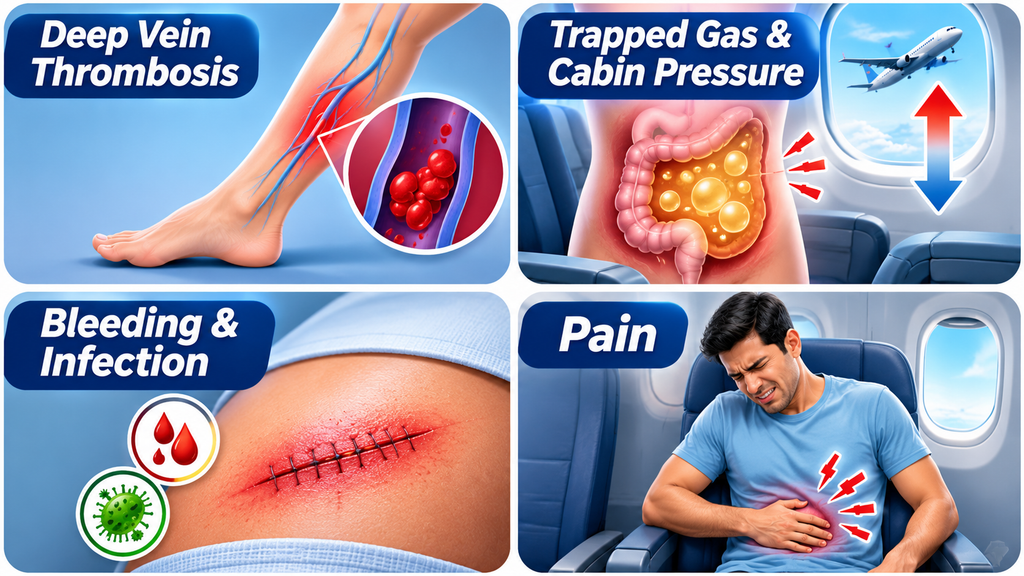
2. Trapped Gas and Cabin Pressure
As the plane climbs, air and gas inside the body expand. At cruising cabin pressure, gas volume increases by roughly a third. This matters after:
- Laparoscopic (keyhole) surgery, where the abdomen is inflated with gas
- Eye surgery with a gas bubble (for retinal detachment or macular repair). Flying with a gas bubble can cause dangerous pressure rise inside the eye and permanent vision loss
- Brain, sinus, chest, and ear surgery, where air may be trapped
3. Bleeding, Infection, and Pain Far From Your Surgeon
If a complication starts at 35,000 feet, you cannot return to your surgical team. Early flying also means long queues, lifting luggage, and sitting in a cramped seat while you are still healing.
How Soon Can You Fly After Surgery? Typical Ranges
The table below shows general ranges commonly cited in medical and aviation guidance. Your own date may be shorter or longer. Treat it as a planning guide, not clearance.
| Procedure type | Typical earliest flight (uncomplicated recovery) | Main concern |
|---|---|---|
| Dental extraction, implants, fillings | 1 to 3 days | Bleeding, pressure after sinus work |
| Hair transplant | 1 to 3 days | Swelling, scalp care |
| LASIK / cataract surgery | 1 to 7 days (as cleared by your eye surgeon) | Infection, eye drops schedule |
| Retinal surgery with gas bubble | Do not fly until the gas is fully absorbed (often 2 to 8 weeks) | Vision loss from gas expansion |
| Laparoscopic gallbladder / appendix | About 1 to 7 days | Residual gas, pain |
| Hernia repair | About 1 to 2 weeks | Strain, wound healing |
| Breast augmentation | About 7 to 14 days | Swelling, bleeding, clot risk |
| Facelift / rhinoplasty | About 7 to 14 days | Swelling, bleeding, bruising |
| Liposuction (large volume) / tummy tuck | About 2 to 3 weeks | High DVT risk, fluid collections |
| Bariatric surgery | About 1 to 2 weeks | Clot risk, dehydration |
| Open abdominal surgery | About 10 to 14 days or more | Gas, wound, clot risk |
| Hip or knee replacement | About 2 to 6 weeks (many surgeons prefer 4 or more) | Very high DVT risk |
| Cardiac surgery (bypass, valve) | About 2 to 4 weeks or longer | Fluid, arrhythmia, wound healing |
| Spine surgery | About 2 to 6 weeks | Mobility, pain, clot risk |
| Neurosurgery / craniotomy | Surgeon-specific, often several weeks | Trapped air, neurological checks |
| Cancer surgery | Surgeon-specific | Depends on site and further treatment |
Important: Complications, anemia, infection, a drain still in place, or a delayed wound check can all push your date back.
What Factors Change Your Flight Date?
Two patients with the same surgery can get different dates. Your surgeon will weigh:
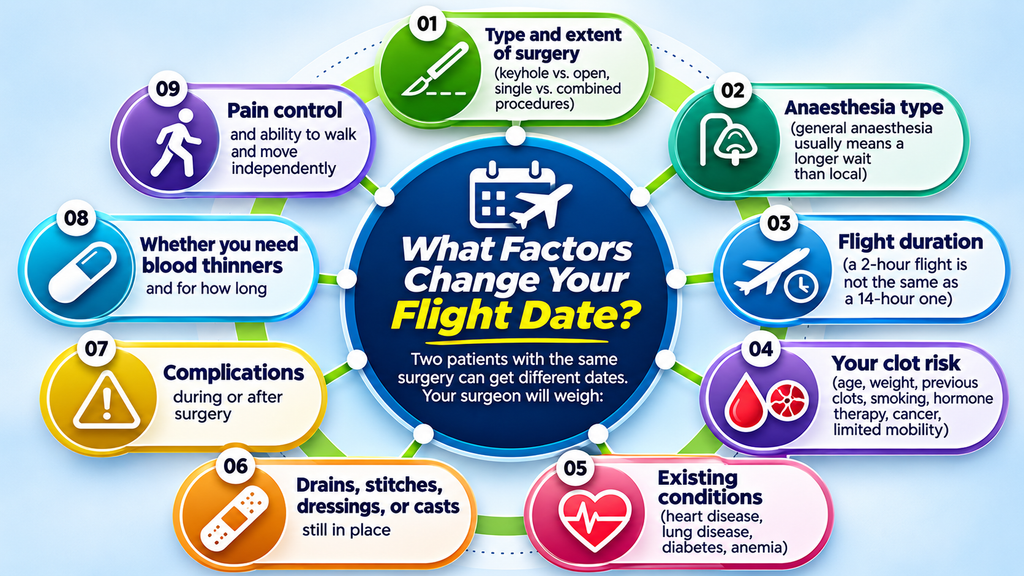
- Type and extent of surgery (keyhole versus open, single versus combined procedures)
- Anesthesia type (general anesthesia usually means a longer wait than local)
- Flight duration (a 2-hour flight is not the same as a 14-hour one)
- Your clot risk (age, weight, previous clots, smoking, hormone therapy, cancer, limited mobility)
- Existing conditions (heart disease, lung disease, diabetes, anemia)
- Drains, stitches, dressings, or casts still in place
- Complications during or after surgery
- Whether you need blood thinners and for how long
- Pain control and ability to walk and move independently
12 Questions to Ask Your Surgeon Before You Book Your Return
Ask these before you buy tickets. Write down the answers.
- What is the earliest date I can safely fly for my specific procedure?
- Does my flight length (hours and number of connections) change that date?
- What is my personal risk of blood clots, and what prevention do you recommend? (compression stockings, blood thinners, walking schedule)
- Do I need a follow-up exam or imaging before I fly? When, and with whom?
- When will drains, stitches, or dressings come out?
- What activity limits apply during travel? (lifting bags, long sitting, stairs)
- Which medications must I take on the flight, and can I carry them in hand baggage?
- What symptoms mean I should not fly, or should seek care immediately?
- Who do I contact if a problem appears after I get home?
- Will you give me a written fit-to-fly letter and a full surgical summary?
- Can you send my records and follow-up plan to my doctor at home?
- If I need to extend my stay, what will extra days, follow-up visits, or complication care cost?
Questions to Ask Your Airline and Insurer
Surgeon clearance is the medical decision. The airline and insurer decide the practical side.
Airline
- Do you require a medical clearance form for recent surgery?
- What is your change and cancellation policy if my date moves?
- Can I arrange wheelchair or mobility assistance?
- Can I choose an aisle or bulkhead seat for leg room?
- Can I carry medical supplies and liquid medication in hand baggage?
Travel insurance
- Does the policy cover complications from planned surgery, or does it exclude them?
- Does it cover emergency medical evacuation and an unplanned return flight?
- Does it cover extra accommodation if I cannot fly on schedule?
- Do I need to declare the procedure in advance? (Many policies exclude undeclared pre-planned treatment.)
How to Book Your Return Flight Smartly
- Book flexible. Choose a refundable or changeable fare, or wait until your surgeon confirms the date.
- Add buffer days. A common approach is to plan a few extra days beyond the earliest cleared date.
- Prefer direct flights. Fewer connections mean less sitting, less walking through terminals, and fewer chances of missed flights.
- Choose an aisle seat so you can stand and stretch.
- Arrange airport help. Wheelchair assistance reduces strain and speeds up security.
- Arrange a ride at home. Do not plan to drive yourself from the airport.
- Pack a cabin bag you can lift easily. Ask someone else to handle heavy luggage.
How to Stay Safe on the Flight
- Walk and move. Stand, walk the aisle, or flex your ankles and calves roughly every 1 to 2 hours.
- Hydrate. Drink water. Limit alcohol and excess caffeine.
- Wear compression stockings if your surgeon recommends them.
- Take medicines as prescribed, including pain relief and any blood thinners.
- Wear loose, comfortable clothing that does not press on your incisions.
- Keep key documents in hand baggage: surgical summary, fit-to-fly letter, medication list with generic names, and emergency contacts.
Warning Signs: Do Not Fly After Surgry and Get Medical Help
Seek urgent care instead of flying if you have:
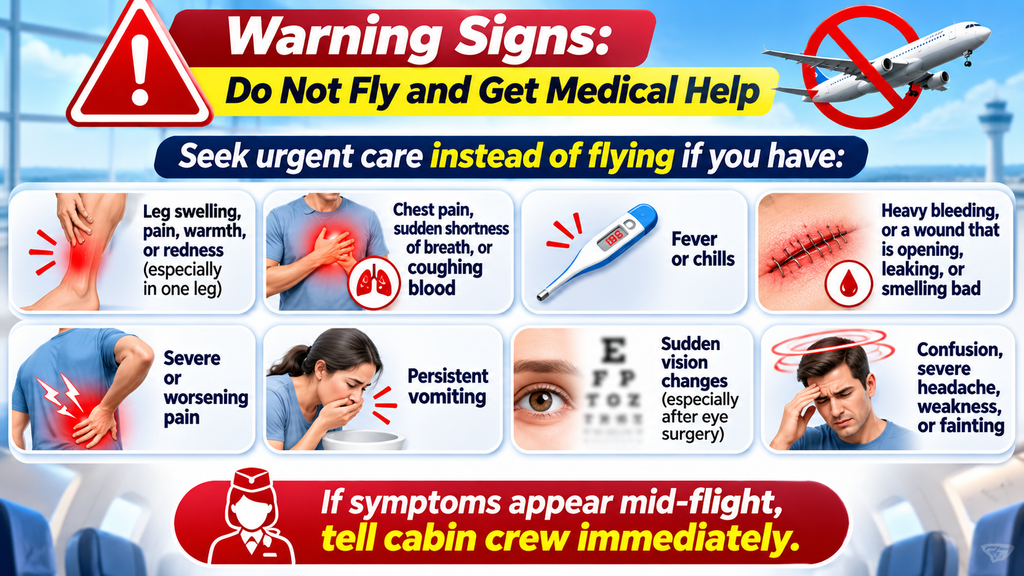
- Leg swelling, pain, warmth, or redness (especially in one leg)
- Chest pain, sudden shortness of breath, or coughing blood
- Fever or chills
- Heavy bleeding, or a wound that is opening, leaking, or smelling bad
- Severe or worsening pain
- Persistent vomiting
- Sudden vision changes (especially after eye surgery)
- Confusion, severe headache, weakness, or fainting
If symptoms appear mid-flight, tell cabin crew immediately.
Plan Recovery Time Into Your Medical Trip
If you are traveling abroad for surgery, treat the return flight as part of your treatment plan, not an afterthought. Before you commit to a procedure and destination, confirm:
- The recommended length of stay after surgery
- Follow-up visits included in the package, and what happens if you need more
- What the hospital’s policy is for complications and readmission
- Whether the surgeon will coordinate with your doctor at home
- Who handles medical records and discharge paperwork
A realistic stay is cheaper and safer than a rushed flight home.
Frequently Asked Questions
How long after surgery can you fly?
It depends on the procedure. Minor surgeries may allow flying in 1 to 3 days. Major surgeries often need 2 to 6 weeks or more. Your surgeon gives the final date based on your recovery and flight length.
Can you fly after general anesthesia?
Many people can fly within 24 to 48 hours after minor procedures under general anesthesia, but the surgery itself usually sets the real timeline. Always confirm with your surgeon.
Can you fly after laparoscopic surgery?
Often within about a day to a week, depending on the procedure. Residual gas in the abdomen can cause pain at altitude, so your surgeon should clear you first.
Is it safe to fly after hip or knee replacement?
It can be, but clot risk is high. Many surgeons prefer 4 or more weeks before long-haul flights, and some allow earlier travel with blood thinners, compression stockings, and frequent movement.
Can you fly after cosmetic surgery?
Usually after about 1 to 3 weeks, depending on the procedure. Tummy tuck and large-volume liposuction carry higher clot risk and generally need longer.
Why can’t you fly with a gas bubble in the eye?
The gas expands as cabin altitude rises. That raises pressure inside the eye and can cause permanent vision loss. Do not fly until your eye surgeon confirms the bubble has fully absorbed.
Do I need a fit-to-fly certificate?
Not always, but airlines may ask for one after recent surgery, and it is wise to carry one. Ask your surgeon for a signed letter stating your procedure, date, and clearance to fly.
Can I take blood thinners on a flight?
Yes, if prescribed. Keep them in hand baggage and take them on schedule. Do not start or stop blood thinners without your doctor’s advice.
Should I fly business class after surgery?
Extra leg room and a lie-flat seat can help comfort and circulation, but class of travel does not replace surgeon clearance.
What if I must fly sooner than recommended?
Talk to your surgeon first. They may suggest extra precautions, a shorter route, or a safer alternative such as medical escort travel. Do not fly early without medical approval.
Bottom Line
The right time to fly home is when your surgeon says it is safe, not when the cheapest ticket appears. Ask the 12 questions above, get clearance in writing, book flexible, and build buffer days into your plan.
Medical disclaimer: This article is for general information only and is not medical advice. Flight timing after surgery depends on your individual condition, procedure, and surgeon’s instructions. Always follow the guidance of your treating medical team and airline requirements.