
By Priya, nurse and pharmacist Last verified against published sources on 4 November 2026. Information, not medical advice
Table of Contents
Knee replacement in India for Bangladeshi patients costs most patients roughly US$3,500 to US$8,500 for one knee (about BDT 4.3 to 10.4 lakh) in published hospital and medical-travel quotes. That figure is the surgery package only. Your total cost also includes visa processing, caregiver costs, flights, accommodation and the days you stay after discharge.
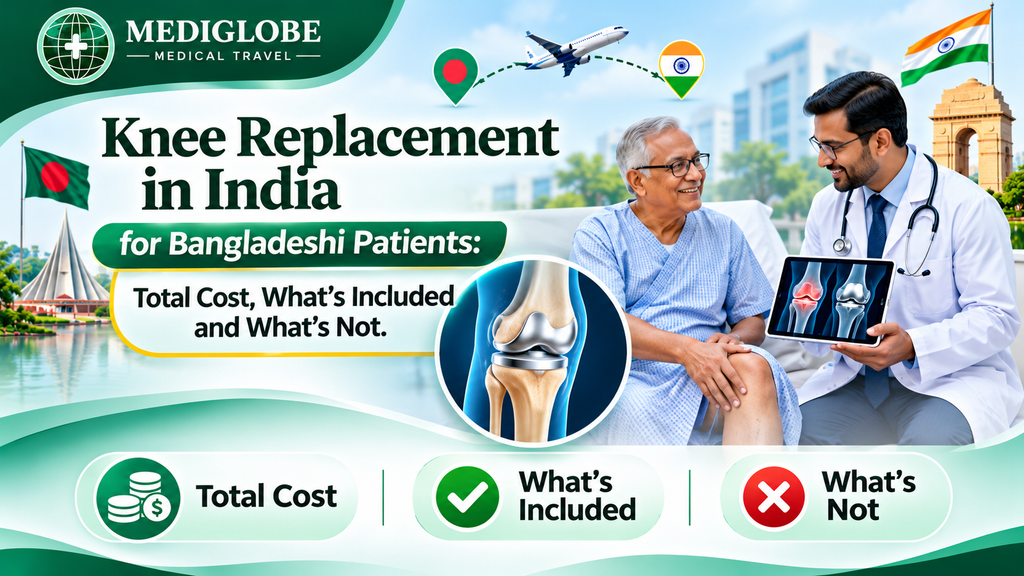
This guide explains what a package normally covers, what it normally leaves out, and how to compare quotes. It also shows how the total fits within Bangladesh Bank’s treatment-remittance limit.
Terms used in this guide
- TKR: total knee replacement
- NPPA: National Pharmaceutical Pricing Authority, India’s price regulator
- IVAC: Indian Visa Application Centre in Bangladesh
- BDT: Bangladeshi taka
Quick facts: knee replacement cost in India for Bangladeshi patients
| Item | What published sources say |
|---|---|
| One knee, standard total knee replacement | About US$3,500–8,500, depending on hospital and implant |
| Both knees, same admission | About US$5,500–12,000 |
| Robotic knee replacement | About US$5,500–11,000 |
| Hospital stay | About 4 days for one knee and 5 for both in one published example; hospitals say 4 to 5 days |
| Time in India for an uncomplicated knee | Published estimates run about 2 to 3 weeks; your surgeon decides |
| Indian visa | No government fee for Bangladeshi passport holders; IVAC charges BDT 1,500 per application |
| Treatment remittance from Bangladesh | Up to US$15,000 per trip through a bank, with up to US$5,000 of it in cash |
| Government benchmark for Indian citizens | CGHS rate for one knee: ₹1,52,000 in a NABH-accredited hospital in a Tier I city (about BDT 1.9–2.0 lakh) |
Important: India does not publish one official price list for foreign patients, because each hospital sets its own international tariff. The surgery ranges above come from hospital and medical-travel websites, so treat them as planning ranges. The government does publish two official benchmarks, covered below: CGHS package rates and NPPA implant price caps.
How much does total knee replacement cost in India
| Treatment / Price Source | Cost (USD) |
|---|---|
| Overall published price range (single knee) | $3,500–$8,500 |
| Source 1 | $4,000–$6,500 |
| Source 2 | $4,000–$7,500 |
| Source 3 | $4,000–$8,000 |
| Source 4 | $3,900–$8,500 |
| Hospital all-inclusive package (starting price) | From $3,500 |
| Both knees (bilateral replacement) | $5,500–$12,000 |
Note: Actual costs vary depending on the hospital, surgeon, implant type and treatment requirements. Bilateral knee replacement costs depend on the hospital.
Why the range is so wide
- The implant brand and material
- Conventional, computer-assisted or robotic technique
- Room type, such as twin-sharing or single room
- The hospital and city
- Your health conditions and whether one or both knees are done
Official price benchmarks from the Indian government
India publishes two official benchmarks that help you judge a quote. Neither is a tariff for foreign patients, because hospitals set their own international prices.
CGHS package rates for the same operation
The Central Government Health Scheme (CGHS) pays fixed package rates to hospitals for Indian central government employees and pensioners. Its office memorandum of 3 October 2025 took effect on 13 October 2025.
For a single total knee replacement (code OR089), the CGHS rate is ₹1,52,000 in a NABH-accredited hospital in a Tier I city, semi-private ward. That is about BDT 1.9–2.0 lakh. The published rate-list entry shows ₹1,36,800 for Tier II cities and ₹1,21,600 for Tier III cities.
The memorandum lists Kolkata, Delhi, Mumbai, Chennai, Bengaluru, Hyderabad, Ahmedabad and Pune as Tier I cities.
Rules in the memorandum that matter to you
- The package covers up to 7 days of indoor treatment for major surgery.
- A second knee in the same session is paid at 50% of the package rate.
- Rates assume a semi-private ward, with 5% less for a general ward and 5% more for a private ward.
- Non-NABH hospitals are paid 15% less than NABH-accredited hospitals.
Related services at CGHS rates (Tier I city, NABH hospital)
| Service | CGHS rate |
|---|---|
| MRI of one knee, without contrast | ₹3,000 |
| X-ray of a knee, two views | ₹380 |
| Orthopaedic rehabilitation after joint replacement, per physiotherapy session | ₹300 |
How to use this. CGHS covers only Indian beneficiaries, so you will not be charged this rate. Use it as a reference point. If a quote is several times higher, ask the hospital to itemise what the difference buys, such as the implant, the room, international patient services and extra days.
The rules and related rates above are from the memorandum. The knee replacement figure is from the published rate list (code OR089), so check it against Annexure I of the memorandum.
What the prices mean in taka
| Amount | Approximate cost in BDT |
|---|---|
| US$3,500 (low end, one knee) | BDT 4.3 lakh |
| US$8,500 (high end, one knee) | BDT 10.4 lakh |
| US$5,500 (low end, both knees) | BDT 6.8 lakh |
| US$12,000 (high end, both knees) | BDT 14.7 lakh |
| US$15,000 (Bangladesh Bank treatment limit per trip) | BDT 18.4 lakh |
These use about BDT 122.8 per US dollar, a 2026 mid-market rate. Your bank’s rate will differ, so check it on the day you remit.
What a knee replacement package usually includes
Packages differ, but published packages commonly list these items:
- Surgeon and anaesthetist fees
- Operating theatre charges and consumables
- A standard implant
- Hospital room and nursing care for the standard stay
- Basic medicines during the hospital stay
- Physiotherapy while you are in hospital
- Pre-operative tests such as blood tests, X-ray and ECG
- Airport pick-up and drop-off, in some packages
What a knee replacement package usually does not include
These are the items that turn a quote into a bigger bill. Ask about each one in writing.
- A longer hospital stay than the package allows
- Medicines and physiotherapy after discharge
- Post-discharge accommodation. One published package prices a post-discharge stay separately from surgery.
- Premium or robotic options. These usually cost more than the base package.
- Complications and extra treatment, such as intensive care or additional procedures
- International flights and visa costs
- Costs for your caregiver, including food and accommodation
- Follow-up scans and visits
Costs outside the hospital bill
Visa. The Government of India charges Bangladeshi nationals no visa fee. IVAC charges BDT 1,500 per application, and your caregiver needs a separate application. See our medical visa guide for Bangladeshi patients for the full document list and steps.
Caregivers. India’s Bureau of Immigration allows up to three medical attendants for Bangladeshi nationals on the regular visa route.
Stay, travel and follow-up. Flights, local transport and any accommodation outside the hospital depend on your dates and city. Ask your hospital for its typical timeline before you book.
Add up your total cost
Write every cost on one line before you choose a hospital:
- Surgery package from the written quote
- Extra hospital days beyond the package
- Medicines, physiotherapy and follow-up scans after discharge
- Post-discharge stay, if the package prices it separately
- Visa processing at BDT 1,500 per application: BDT 3,000 for a patient and one caregiver, BDT 4,500 with two
- Return flights for you and your caregiver
- Your caregiver’s meals and accommodation
- Local transport
- A reserve for extra days or unexpected treatment
Compare the total with the Bangladesh Bank limit described below before you commit.
Why knee implant prices in India are regulated
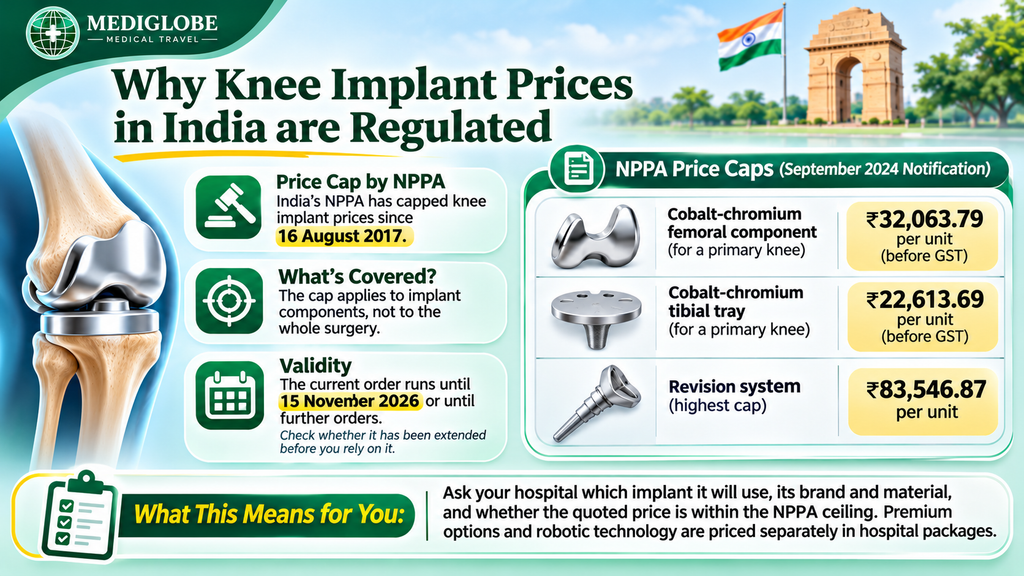
India’s NPPA has capped knee implant prices since 16 August 2017. The cap applies to implant components, not to the whole surgery. The current order runs until 15 November 2026 or until further orders, so check whether it has been extended before you rely on it.
Under the September 2024 notification, a cobalt-chromium femoral component for a primary knee is capped at ₹32,063.79 per unit before GST. A cobalt-chromium tibial tray is capped at ₹22,613.69 per unit before GST. The highest cap in that notification, for a revision system, is ₹83,546.87 per unit.
What this means for you: Ask your hospital which implant it will use, its brand and material, and whether the quoted price is within the NPPA ceiling. Premium options and robotic technology are priced separately in hospital packages.
Will it fit within Bangladesh Bank’s limit?
Bangladesh Bank allows banks to remit up to US$15,000 per trip for treatment abroad, supported by hospital or doctor documents. Up to US$5,000 of this can be cash.
A single-knee package of US$3,500–8,500 fits inside that limit with room left for other costs. Both knees at the top of the published range, plus a caregiver and a longer stay, can approach it. Larger amounts need central bank approval through your bank, so ask your bank early.
9 questions to ask before you pay
- Which implant brand and material are included, and is its price within the NPPA ceiling?
- How many hospital days does the package cover, and what is the daily rate after that?
- Is the room twin-sharing or single?
- Are pre-operative tests, medicines and in-hospital physiotherapy included?
- What do medicines, physiotherapy and follow-up scans cost after discharge?
- What happens if I need intensive care or extra treatment?
- Does the quote include my caregiver’s room or meals?
- Which currency and payment method does the hospital accept?
- What is the refund or cancellation policy if my visa is delayed?
How to compare two quotes
Ask each hospital to fill in the same items. This table shows what to compare.
| Item | Hospital A | Hospital B |
|---|---|---|
| Package price (single or both knees) | ||
| Implant brand and material | ||
| Included hospital days | ||
| Room type | ||
| Medicines and physiotherapy after discharge | ||
| Extra-stay daily rate | ||
| Complication cover | ||
| Airport pick-up and local help |
Frequently asked questions about knee replacement in India for Bangladeshi patients
How much does knee replacement cost in India for a Bangladeshi patient?
Published quotes for one knee run from about US$3,500 to US$8,500, and about US$5,500 to US$12,000 for both knees. Your final cost depends on the hospital, implant and your health.
What is included in a knee replacement package in India?
Usually surgeon and anaesthetist fees, theatre charges, a standard implant, the hospital stay, nursing, basic medicines and physiotherapy during admission. Confirm each item in writing.
What is usually not included?
A longer stay, medicines and physiotherapy after discharge, flights, visa costs, caregiver costs, premium implants and treatment for complications.
How long do I stay in India for knee replacement?
Published estimates run about 2 to 3 weeks for an uncomplicated single knee. Your surgeon decides when you can travel home.
Is there a limit on how much money I can take from Bangladesh for treatment?
Bangladesh Bank allows banks to remit up to US$15,000 per trip, with up to US$5,000 in cash. Larger amounts need approval through your bank.
Does my caregiver need a separate visa?
Yes. Each caregiver applies separately for a Medical Attendant visa, and IVAC charges BDT 1,500 per application.
Sources used
- Joint replacement hospital guide for international patients
- MedSurge India: knee replacement cost
- Wellness Destination India: bilateral knee replacement cost
- Medical Dialogues: NPPA extends knee implant price cap to 15 November 2026
- Pharmabiz: NPPA ceiling price extension, November 2025
- Care Hospitals: NPPA knee implant ceiling price list
- IVAC Bangladesh: for Bangladeshi nationals (visa fees)
- The Financial Express (Bangladesh): treatment remittance limit
Added sources
- CGHS office memorandum, 3 October 2025 (rate rules and related service rates)
- CGHS rate-list entry: total knee replacement, unilateral (OR089)
- USD to BDT mid-market rate
This article is general information, not medical or financial advice. Prices change, and your surgeon and hospital decide the right operation, implant and stay for you.