
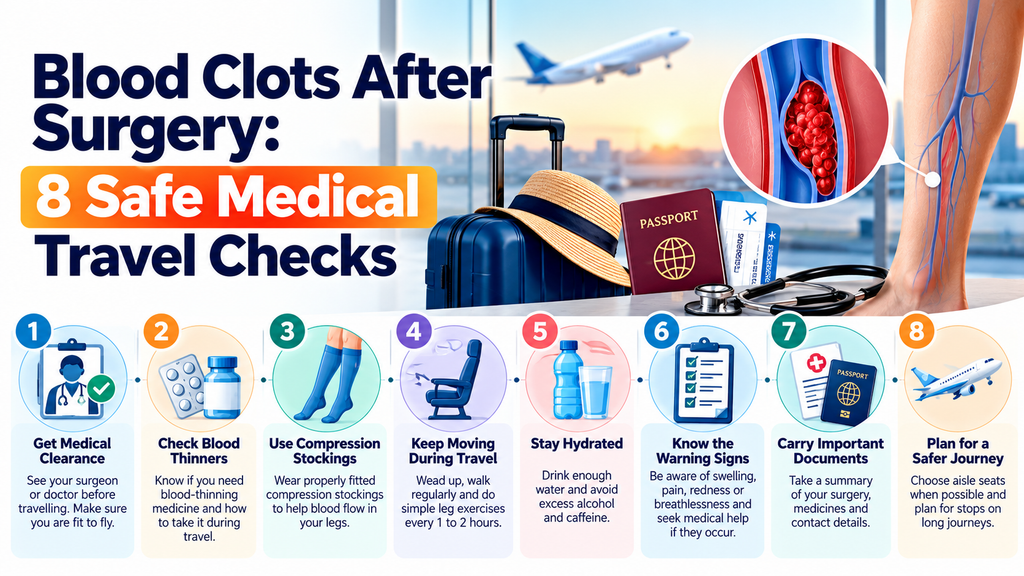
Table of Contents
Blood Clots After Surgery and Long Flights: A Medical Travel Guide to Warning Signs and What to Ask Your Surgeon
By Priya, nurse and pharmacist | Last reviewed: October 30, 2026
Blood clots after surgery are uncommon, but they are one of the most important risks to plan for when you fly home after treatment abroad. Recent surgery and long journeys each raise the risk of a clot in the leg, and in rare cases the clot can travel to the lungs and become an emergency. Know the warning signs, ask your surgeon about your own prevention plan before you book your return flight, and never ignore sudden breathlessness or chest pain.
If you are travelling for treatment, this guide explains what the risk really is, who is more likely to be affected, what to watch for, and which questions to ask your surgeon. It is based on guidance from the CDC and the NHS, and I link every source at the end.
This is general education, not personal medical advice. Your surgeon and your own doctor decide what is right for you.
What Is a Blood Clot After Surgery?
A blood clot is a clump of blood that blocks a blood vessel. After surgery, the most common type forms in a deep vein of the leg. This is called deep vein thrombosis (DVT).
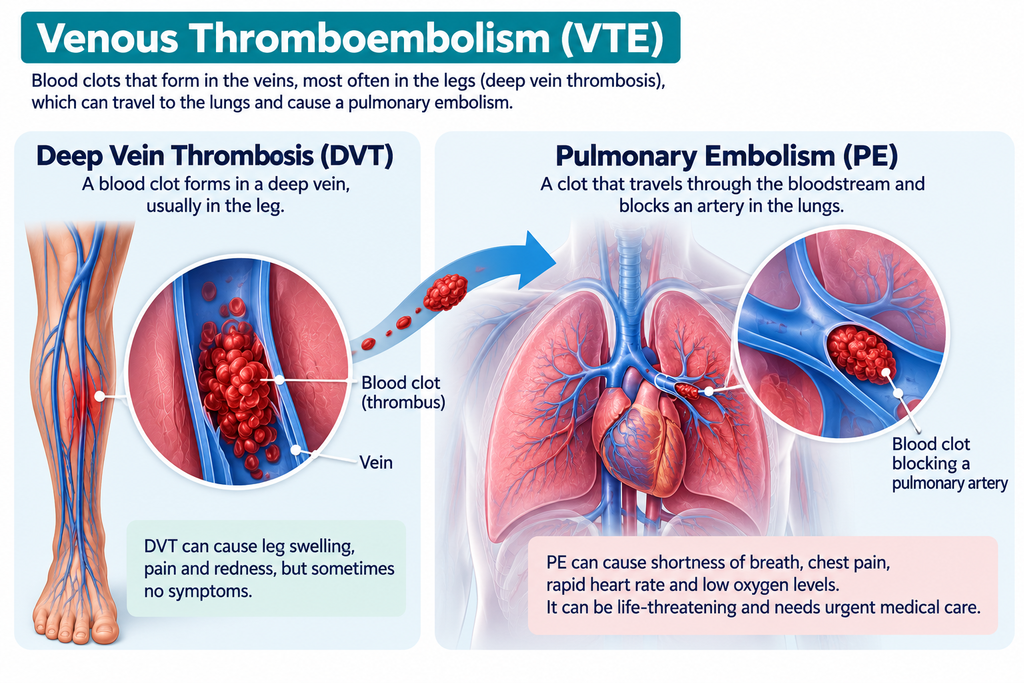
The danger is that part of the clot can break off and travel to the lungs. This is called a pulmonary embolism (PE). The NHS explains that DVT can be very serious because blood clots can travel to the lungs, and a pulmonary embolism can be life-threatening and needs treatment straight away.
Doctors group both conditions under one name: venous thromboembolism (VTE).
Why Surgery and Long Flights Both Raise the Risk
Two things happen together.
After surgery, you move less, and your body’s blood clotting changes as part of healing. Hospitals know this. The NHS notes that healthcare teams should check whether you have a higher chance of DVT when you go into hospital, and may give medicine or compression stockings to prevent it.
On a long journey, sitting still slows blood flow in the legs. The CDC explains that prolonged, cramped sitting during long-distance travel interferes with blood flow in the legs, creating venous stasis. The same increase in risk applies to other long journeys such as car, bus or train. cdc
The CDC also states that most travel-related clots occur in travellers who already have risk factors, and that combining air travel with these risk factors may increase the risk more than either one alone. Recent surgery is on that list.
How Big Is the Risk?
It is important to be honest about this. Overall, the risk is low, but it is higher after surgery.
The CDC Yellow Book reports that the incidence of symptomatic clots in the month after travel is about 1 in 4,600 flights longer than 4 hours, and the risk is greater in people with known risk factors such as recent surgery or trauma. That figure is for travellers in general. It is not a figure for patients who have just had an operation.
For patients, the evidence is less clear. One systematic review of surgical patients who flew soon after surgery found pooled DVT rates of 0.67% in those who had surgery and recent air travel, compared with 0.45% in surgery alone. The ranges around these numbers were wide, which means the studies could not give a firm answer. Do not read this as proof that flying is safe. It shows that we need more evidence, and that your surgeon’s advice about your own case matters most.
Who May Be at Higher Risk?
Your surgeon will assess your own risk, but these factors are known to increase it:
- recent surgery, hospitalisation or injury. The CDC lists recent surgery or injury within the last 3 months as a risk factor for travel-related clots.
- a previous clot (DVT or PE)
- cancer or recent cancer treatment
- age over 60, according to the NHS, or over 40 according to the CDC
- being overweight
- smoking
- hormonal medicines such as the contraceptive pill or HRT
- heart failure or varicose veins
- pregnancy, or having had a baby in the last 6 weeks
- dehydration
The NHS lists several of these, including being over 60, overweight, a smoker, having had DVT before, taking the pill or HRT, having cancer or heart failure, or having varicose veins.
If you have any of these, tell your surgical team before you travel.
8 Warning Signs of a Blood Clot
Signs of DVT (a clot in the leg)
The NHS describes these signs in the leg: throbbing pain, swelling, warm skin around the painful area, red, blue or darkened skin (harder to see on brown or black skin), and swollen veins. The pain is usually in the calf or thigh, and usually affects one leg only.
- Throbbing pain in one leg, usually the calf or thigh
- Swelling in one leg
- Warm skin around the painful area
- Red, blue or darkened skin around the painful area
- Swollen veins that are hard or sore to touch
Signs of a pulmonary embolism (a clot in the lung)
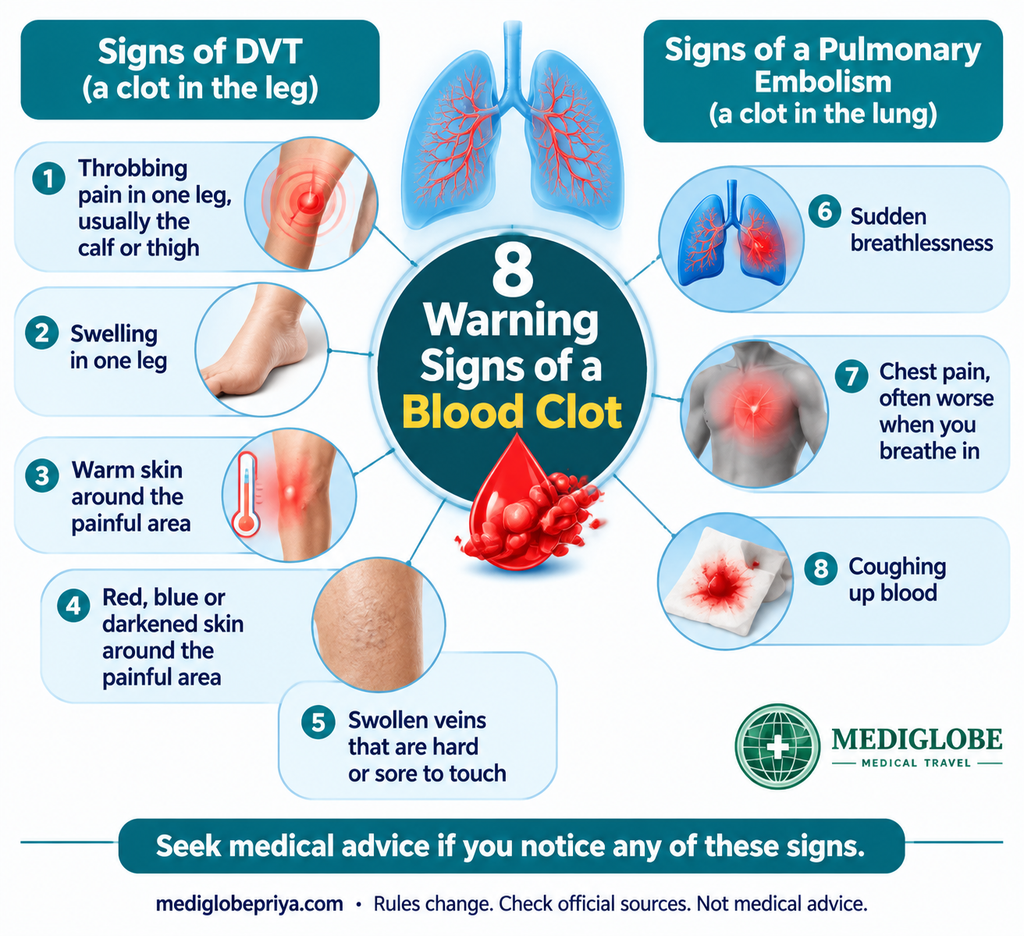
The NHS lists these signs: difficulty breathing that comes on suddenly, chest pain that is worse when you breathe in, and coughing up blood.
- Sudden breathlessness
- Chest pain, often worse when you breathe in
- Coughing up blood
What to do
- Suspected DVT (leg signs only): get urgent medical help the same day. The NHS advises that if a doctor thinks you have DVT, you should be referred to hospital within 24 hours for an ultrasound scan.
- Leg signs plus breathlessness or chest pain, or any signs of a PE: this is an emergency. Call your local emergency number (112 in India, but check the number for the country you are in) or go to the nearest emergency department.
- Do not drive yourself. The NHS advises that you ask someone to drive you or call an ambulance, and bring any medicines you take.
- Tell the doctors that you recently had surgery and a flight. This is vital information.
Clots can appear after you land or after you get home, not only during the flight. Do not dismiss new leg pain or swelling because “the flight is over.”
How Clots Are Prevented
Prevention is usually a combination of things, and your surgeon chooses what suits you.
In the hospital: early walking, leg exercises in bed, compression stockings or blood-thinning medicine for patients at higher risk.
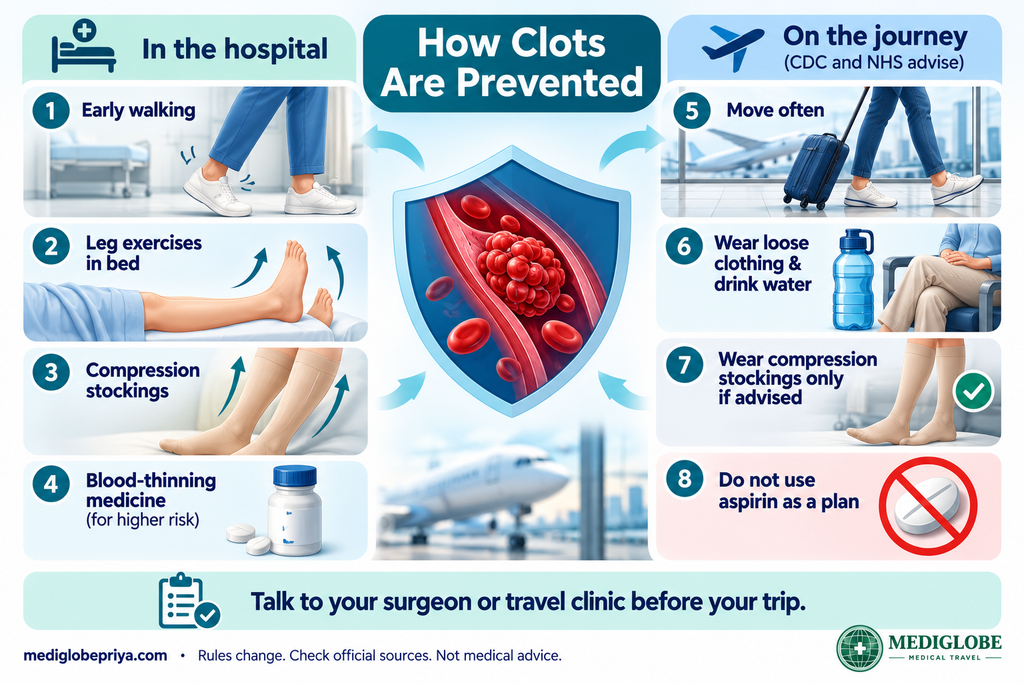
On the journey, the CDC and NHS advise:
- Move often. The CDC advises you to move your legs frequently and walk around every 1 to 2 hours. The CDC also notes that frequent walking and calf muscle exercises are reasonable for long-distance travellers.
- Wear loose clothing and drink plenty of water. The NHS also advises avoiding alcohol, walking around when possible, and not crossing your legs while sitting.
- Wear compression stockings only if advised. The CDC says people with risk factors might benefit from properly fitted graduated compression stockings (15 to 30 mmHg at the ankle) during flights. They must fit properly, so ask your surgeon or pharmacist about size.
- Do not use aspirin as a plan. The CDC notes that aspirin has not been shown to decrease the risk. Never take blood thinners or aspirin for travel unless a doctor tells you to.
For travellers at substantially increased risk, such as those with recent surgery, a hematology guideline panel suggests that compression stockings or low molecular weight heparin (a blood-thinning injection) may be considered. Whether you need an injection is a medical decision for your surgeon. Never decide for yourself.
What to Ask Your Surgeon Before You Book Your Return Flight
Write these questions down and ask them before you book your return flight:
- What is my own risk of a blood clot, based on my surgery and my health?
- What prevention did I get in the hospital, and what do I need after discharge?
- Do I need blood-thinning medicine after I leave? For how long, who prescribes it, and how do I carry and take it?
- Do I need compression stockings? What size and strength, and who fits them?
- When is it safe for me to fly? Please write it down for me.
- How long can my flight and my layovers be? Should I plan a stop to break up the journey?
- What exercises and walking should I do in the hospital, at my stay and on the plane?
- Should I change any medicines before travel, such as hormonal medicines?
- Which warning signs should I watch for, and who do I call, day or night?
- Can you give me a summary that I can show to a doctor at home or abroad if I have a problem?
If your surgeon cannot answer, ask the hospital to refer you to a doctor who can.
A Plan for Medical Travel
- Ask for it in writing. Request a discharge summary that states the surgery done, the clot prevention you received and your follow-up plan.
- Keep your return ticket flexible. If your surgeon does not clear you to fly on the planned date, you can change it without panic.
- Take a companion who knows the warning signs.
- Stay near the hospital during the first days of recovery, if your doctor advises it.
- Plan follow-up at home. Tell a doctor at home before you travel, and share your records.
- Carry your medicines in hand luggage, with your doctor’s letter.
- If you have had a clot before, tell your team. The NHS advises that people who start treatment for DVT should delay flights or long journeys until at least 2 weeks after they start taking blood-thinning medicine.
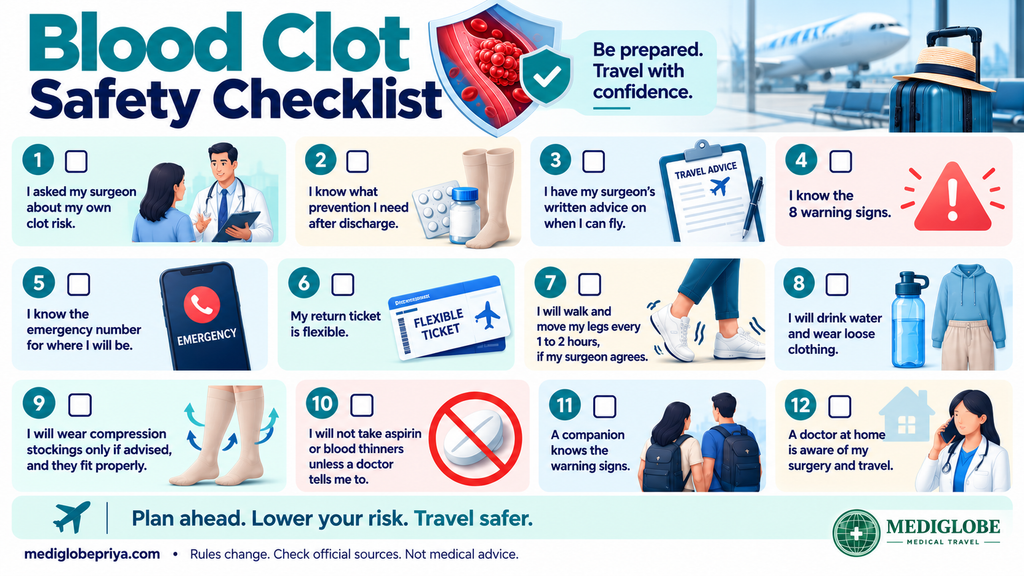
Blood Clot Safety Checklist
- I asked my surgeon about my own clot risk
- I know what prevention I need after discharge
- I have my surgeon’s written advice on when I can fly
- I know the 8 warning signs
- I know the emergency number for where I will be
- My return ticket is flexible
- I will walk and move my legs every 1 to 2 hours, if my surgeon agrees
- I will drink water and wear loose clothing
- I will wear compression stockings only if advised, and they fit properly
- I will not take aspirin or blood thinners unless a doctor tells me to
- A companion knows the warning signs
- A doctor at home is aware of my surgery and travel
Frequently Asked Questions
What are the signs of a blood clot after surgery?
Leg signs include throbbing pain, swelling, warm skin and red or darkened skin, usually in one leg. Signs of a clot in the lung include sudden breathlessness, chest pain and coughing up blood. Get urgent medical help for leg signs, and emergency help for breathing or chest symptoms.
Can I fly after surgery?
There is no single safe date. It depends on your operation, your recovery and your own risk. Ask your surgeon in writing before you book.
How long after a flight can a clot appear?
The CDC measures risk over the month after travel. So report new leg pain, swelling or breathlessness during that time, even if the flight is over.
Should I take aspirin before a flight?
No, not as a plan. The CDC says aspirin has not been shown to decrease the risk. Only your doctor can tell you if you need medicine to prevent clots.
Do compression stockings help?
They may help people with risk factors, if they are properly fitted. Ask your surgeon or pharmacist whether you need them, and which size.
Is it safe to fly soon after surgery?
Some evidence suggests the added risk may be small, but it is uncertain. Your surgeon’s advice about your own case matters most.
Sources
- CDC Yellow Book 2024, “Air Travel”: wwwnc.cdc.gov/travel/yellowbook/2024/air-land-sea/air-travel (accessed October 30, 2026)
- CDC Yellow Book 2020, “Deep Vein Thrombosis and Pulmonary Embolism”: wwwnc.cdc.gov/travel/yellowbook/2020/travel-by-air-land-sea/deep-vein-thrombosis-and-pulmonary-embolism (accessed October 30, 2026)
- NHS 111 Wales, “DVT (deep vein thrombosis)”: 111.wales.nhs.uk (adapted from NHS UK, accessed October 30, 2026)
- Systematic review and meta-analysis of VTE risk in surgical patients with recent air travel: ncbi.nlm.nih.gov/pmc/articles/PMC12812180 (accessed October 30, 2026)
- The Blood Project (American Society of Hematology), “Air Travel and Venous Thromboembolism”: thebloodproject.com (accessed October 30, 2026)
Educational information, not medical advice. If you think you have a blood clot, get medical help immediately. Always follow your own surgeon’s advice about flying after surgery.
About the author: Priya is a nurse and pharmacist (B.Sc. Nursing, D.Pharm) with around 8 years of clinical and academic experience, and the founder of MediGlobe.