
Table of Contents
By Priya, nurse and pharmacist · Last reviewed: 27 October 2026 · Information, not medical advice.
Vaccines Before Medical Travel: What to Check and When to See a Travel Clinic
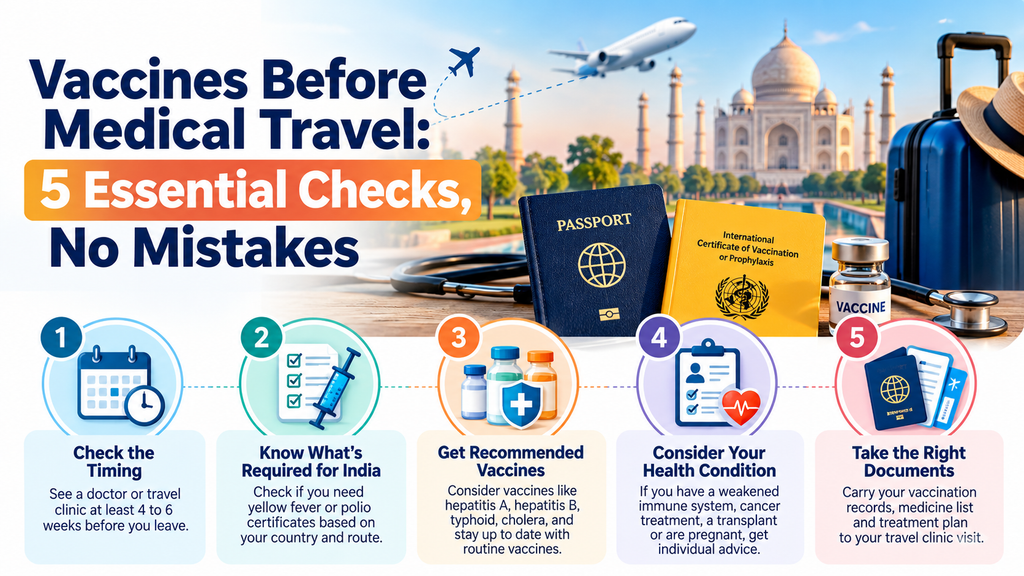
Planning treatment in India? Most people focus on the hospital, the visa and the cost, and forget vaccines. That can cause problems: some vaccines take weeks to work, one missing certificate can delay you at the airport, and some health conditions change which vaccines are safe. This guide shows what to check, in what order, and when to see a travel clinic. It covers India, because that is where MediGlobe starts. Rules differ for other countries.
The short answer
- See your doctor or a travel clinic at least 4 to 6 weeks before you leave [3].
- Check two lists separately: vaccines required to enter India, and vaccines recommended for your health.
- Take your vaccination records, medicine list and treatment plan to the visit.
- If your illness or treatment weakens your immune system, talk to your treating doctor before any vaccine. Some vaccines may not be safe for you [3].
- Rules change and differ by country. Confirm with official sources close to your travel date.
Required or recommended: they are not the same
Required vaccines are about entering a country. If you don’t have the certificate, you can be stopped, held or vaccinated at the airport. Recommended vaccines are about your health. Nobody checks them at the border, but they can protect you during the trip and during a hospital stay.
Ask the clinic to write your vaccines in three groups on paper: required, recommended, optional. It is the same question you should ask about a hospital estimate: what is included, what is extra, and what is optional.
What India requires
Yellow fever certificate
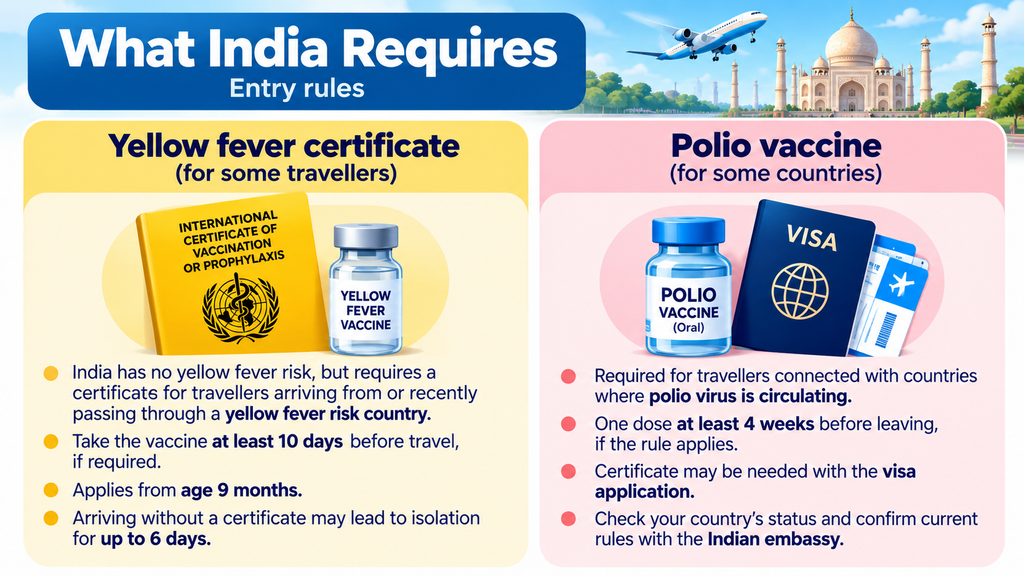
India itself has no yellow fever risk [7], but it asks for a certificate from travellers who come from, or recently passed through, countries with yellow fever risk. The CDC Yellow Book says a traveller arriving by air or sea without a certificate can be held in isolation for up to 6 days if they arrive within 6 days of leaving a risk area [1][7]. The requirement applies from age 9 months [8]. India’s mission in Nairobi tells travellers from Kenya to carry the certificate and to take the vaccine at least 10 days before travel [6].
What to do: check whether your country, or any country you pass through, is on India’s current list. Use the Ministry of Health’s point-of-entry website and your nearest Indian embassy or high commission. Get the vaccine at an approved centre and keep the yellow card with your passport.
Polio vaccine (for some countries)
In April 2024, India’s Ministry of Health issued a rule about oral polio vaccine for travellers connected with countries where polio virus is circulating. For residents of those countries, it says one dose should be given at least four weeks before leaving, a certificate is needed with the visa application, and anyone arriving without one is vaccinated at the airport [5]. Nigeria is on that document’s list of polio-endemic countries [5].
Official pages can differ. One Indian High Commission page says oral polio vaccine is not required for travel from Kenya, while another page from the same mission tells travellers from Kenya to carry both certificates [6]. If your country is not clearly covered, email the embassy, ask for the rule in writing, and keep the reply.
Why this matters
A missing required certificate can cost you days, money and a missed hospital appointment. Check it before you book flights, not at the airport.
What is recommended for your health
For India, the CDC says all travellers should be up to date with routine vaccines, and recommends hepatitis A, hepatitis B and COVID-19 vaccination, with advice varying by age [1]. In more detail [2]:
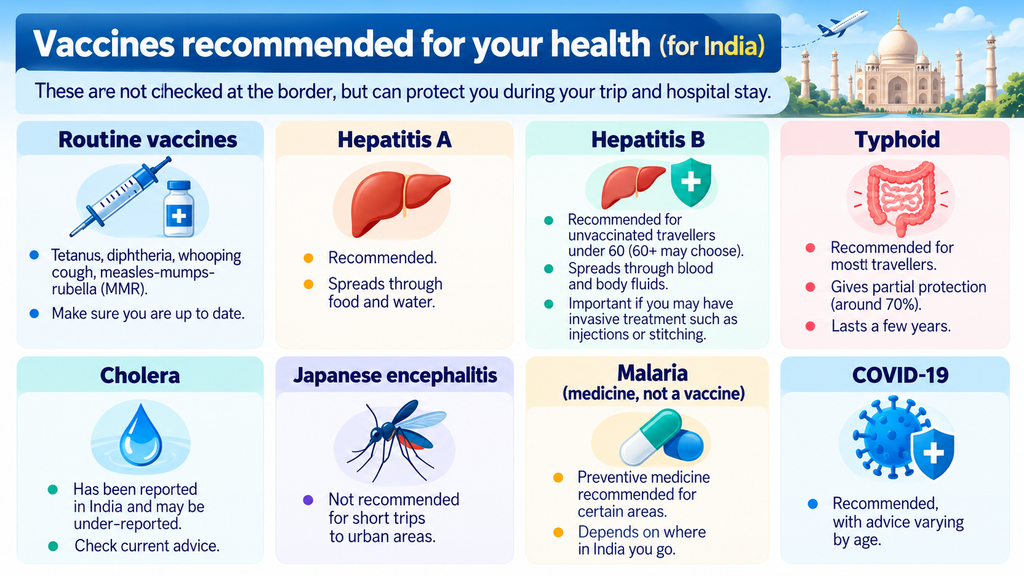
- Routine vaccines (such as tetanus, diphtheria, whooping cough, and measles-mumps-rubella): make sure you are up to date. The CDC says all international travellers should be fully vaccinated against measles.
- Hepatitis A: recommended. It spreads through food and water.
- Hepatitis B: recommended for unvaccinated travellers under 60, and people 60 and over may choose to get it. It spreads through blood and body fluids. Travel-medicine guidance also says people who may have invasive treatment, such as injections or stitching, should be immunised [9]. Ask your clinic whether this applies to your planned treatment.
- Typhoid: recommended for most travellers. One review notes the vaccine gives partial protection, around 70%, and lasts a few years [12], so safe food and water habits still matter.
- Cholera: the CDC notes that cholera has been reported in India and may be under-reported. Check its destination page for current advice [1].
- Japanese encephalitis: the CDC does not recommend it for short trips to urban areas [2].
- Malaria: the CDC recommends preventive medicine for travel to certain areas [2]. This is a medicine, not a vaccine, and depends on where in India you go.
Which of these you need depends on your age, health, itinerary and past vaccines. Only a clinician who knows your records can decide.
When to see a travel clinic
Ideal: 4 to 6 weeks before you leave [3]. That gives time for the vaccines to work and for second or third doses.
Closer than 4 weeks? Still go. Some protection is better than none, and the clinic can tell you what to prioritise. Don’t skip a required certificate because time is short.
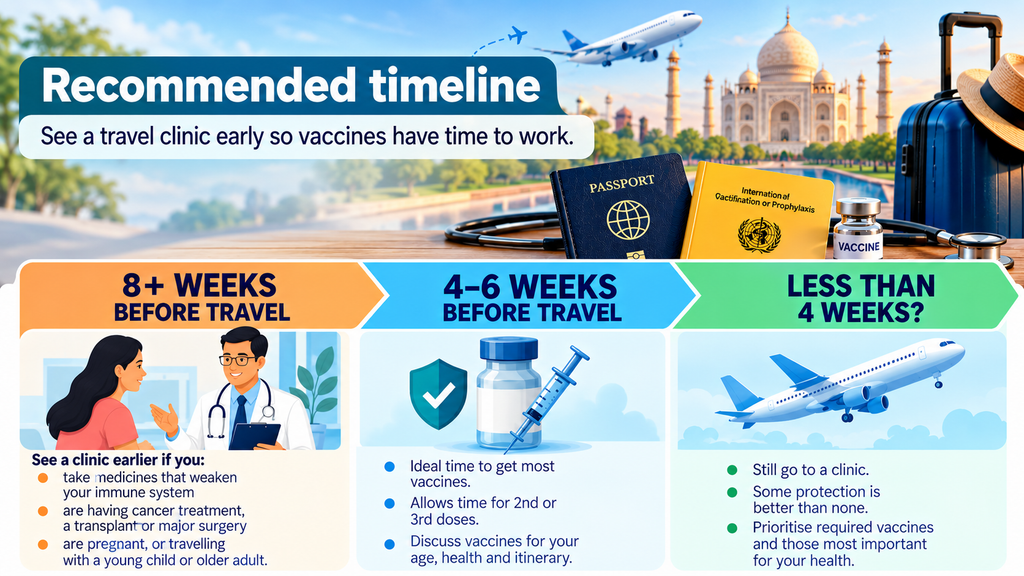
See a clinic earlier (6 weeks or more) if:
- You take medicines that weaken your immune system. Specialist advice suggests getting travel advice at least six weeks before departure [11].
- You are having cancer treatment, a transplant or major surgery.
- You are pregnant, or travelling with a young child or an older adult.
If your immune system is weakened
Live vaccines, such as measles-mumps-rubella and chickenpox, may not be safe for people with weakened immune systems [3]. Yellow fever is also a live vaccine, and the CDC’s guidance for immunocompromised travellers treats it with extra caution [4].
What to do:
- Tell your treating specialist about your travel plan before any vaccine.
- Ask whether vaccines should be given before your treatment starts. One review says to give vaccines ideally at least 2 weeks before starting immune-suppressing treatment [10].
- If a required vaccine is not safe for you, ask your doctor about a medical waiver letter, and check early whether the Indian authorities will accept it [3].
- Send your vaccine list and medicine list to the hospital’s international patient desk before you travel.
What to take with you
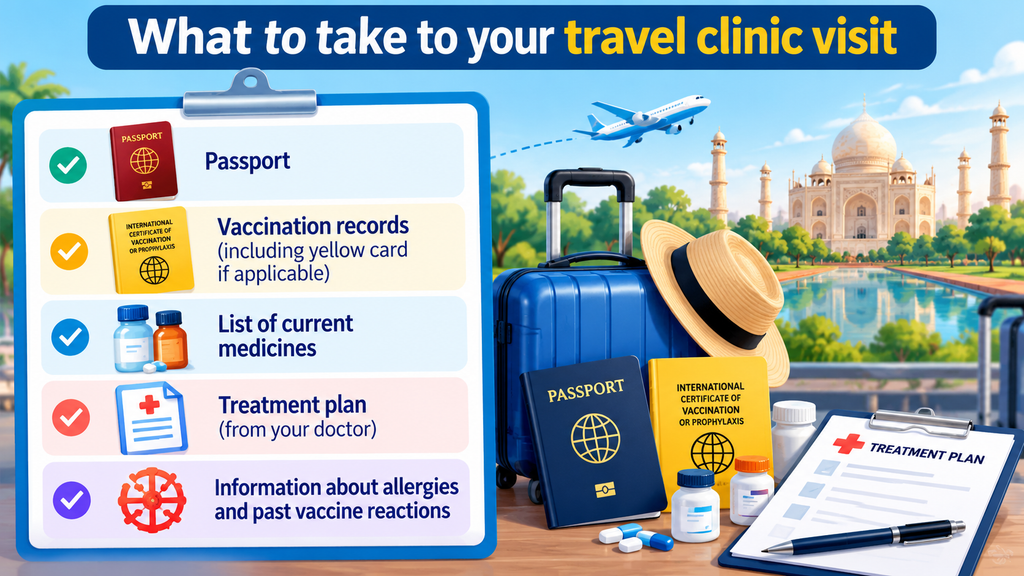
- Passport and yellow fever or polio certificates if required
- Your vaccination record, with dates and vaccine names
- A list of your current medicines and allergies [11]
- A summary from your own doctor
- Your travel clinic’s written advice
A simple timeline
- As soon as you plan: check the required certificates for your country and route.
- 8 to 12 weeks before: if your treatment may weaken your immunity, talk to your treating doctor.
- 4 to 6 weeks before: travel clinic visit.
- At least 4 weeks before: polio dose, if India’s rule applies to your country [5].
- At least 10 days before: yellow fever vaccine, if required [6].
- Travel week: put certificates and records in your hand luggage.
Questions to ask the travel clinic
- Which vaccines are required for my country and route, and which are only recommended?
- Which do I need, given my illness, age and planned treatment?
- Are any live vaccines unsafe for me?
- What does each vaccine cost, and which ones are optional?
- How many doses do I need, and by when?
- What certificate will I receive, and does it cover everything the border may ask for?
- Should I check with my treating doctor first?
What we could not confirm
- Rules for every nationality and route. They differ, and official pages sometimes disagree.
- Whether your hospital checks your vaccines before admission. Ask its international patient desk.
- Costs. They vary by country and clinic, so ask for each price in writing.
Frequently asked questions
Do I need all of these vaccines? No. The clinic decides based on your records, health and itinerary. Required vaccines are separate from recommended ones.
Is this only about the trip? No. Vaccines can also protect you during a hospital stay, and some need careful timing around your treatment. That is why your treating doctor and the travel clinic should talk.
Sources (reviewed 27 October 2026)
- CDC Yellow Book, India: https://www.cdc.gov/yellow-book/hcp/asia/india.html
- CDC Travellers’ Health, India: https://wwwnc.cdc.gov/travel/destinations/clinician/extended_student/india
- CDC, Travellers with Weakened Immune Systems: https://wwwnc.cdc.gov/travel/page/weakened-immune-systems
- CDC Yellow Book, Immunocompromised Travellers: https://www.cdc.gov/yellow-book/hcp/travelers-with-additional-considerations/immunocompromised-travelers.html
This article is general information, not medical advice. It does not replace advice from your own doctor or a travel clinic. Rules and recommendations change, so check the linked sources close to your travel date. If we got something wrong, tell us, and we will correct it.